Episode Transcript
[00:00:11] Speaker A: What's worthwhile considering what we consume, believe, say and do towards peace of mind,
[00:00:18] Speaker B: vitality of body, and joy of spirit?
[00:00:22] Speaker A: I'm Ramsey Zimmerman. Here's some more healthy living motivation and discussion.
[00:00:31] Speaker C: You're not really trying to prove other people wrong, which might have been the case before. You're trying to do something out of love and passion for yourself that can help people. That's something bigger than yourself.
But you're also in a place where you aren't really in a place where you're trying to prove anything.
And the other part, I would say of it, too, is really being mindful of what really matters in terms of, you know, what is success to me. Oftentimes could be as simple as, hey, I woke up this morning, my family's still here, we have something meaningful to do, and there's love in the house.
[00:01:15] Speaker B: Hey there. It's Ramsey here.
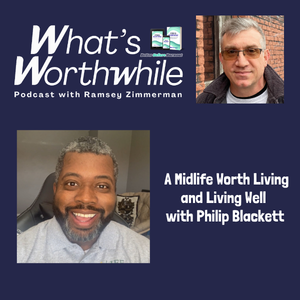
[00:01:17] Speaker A: That was Philip Blackett. Philip sees a lot of things differently
[00:01:21] Speaker B: now that he's over 40.
Where he used to feel like he
[00:01:25] Speaker A: had boundless energy and everything to prove, now he understands that rest and recovery are essential and that there are more important things in life than those we constantly chase after these days. He works with folks in midlife to live their purpose, reclaim their energy, and rebuild their health. Philip's belief and message is this.
Midlife is worth living and worth living well.
I found him to be genuine, calming, and inspiring.
Let's see what you think.
[00:01:58] Speaker B: Hey, Philip, how are you doing today?
[00:02:00] Speaker C: Good. Ramsey, how are you?
[00:02:03] Speaker B: I am doing great.
Thanks for coming in today. I appreciate it. Looking forward to talking to you.
You're the. You're the founder of lifeafter40.com and, and I understand you turned 40 on Thanksgiving Day a couple of years ago and you realized some things. What was that all about?
[00:02:27] Speaker C: Well, I think for me, you know, So I turned 40, Thanksgiving in 2024.
And it was great for a number of reasons where it's like we, we, as in my family, we recently relocated at that time, probably about six or so months ago, from Boston down to Orlando to be closer to family. So this was the first Thanksgiving we were having in the neighborhood because some of our family is literally two houses down. And so basically we were around the dinner table a lot to be grateful for.
You know, obviously we relocated.
I got my wife, my twin daughters, you know, changing a new assignment for me work wise and that sort.
So a lot of things on the outside that I would say are much to be grateful for, but when you dig a little deeper on the inside, there were a lot of things that weren't so apparent to the outside eye, One of which was I was pretty burned out because I had ran a business before I.
During COVID for the past four years, which was very much all consuming, would probably be a close word to characterize it for me personally.
And so it took a lot out of me during that whole timeline, during that whole process as well. I wasn't in the best of health, so I was overweight. I was part of the 300 Club, but not the 300 Club you probably want to be a part of.
And I just had a lot less energy than before, and I didn't really want to do much, you know, yes, I'm a relatively young father, but I didn't have much energy to want to play with my kids, spend time with my wife. You know, it's just kind of like once work was done, I really wanted to just kind of plop down on the couch and drink a cold one. One being Dr. Pepper for me, and then just call it a day.
So I think a lot of it was, you know, sometimes certain moments come up where you start to use as reflection.
And of course, 40 was like the milestone. It's like the culturally accepted time where you say, hey, if you're gonna have a midlife crisis, this is the perfect time for you to have one.
And so for me, I think it was more internal, where you just had these thoughts of, like, okay, where is life come up to up to this point?
Am I happy with it?
And if not, what do you want to do with it? Because, God willing, there may be a lot more life left over, and you don't want to just kind of like, check it in and go through the motions for the rest of your life, even though some people do that.
And so I think that just really started me on a journey to figure out, okay, where is my purpose at this point in this chapter? What's the meaning?
And let that kind of lead me to where things go from there.
[00:05:39] Speaker B: Yeah.
Yeah. So what was your life like up until that point leading up to age 40? Like, what were you doing professionally? What were, you know, your interests? What. What was life like for you before that time?
[00:05:59] Speaker C: Yeah, so that's. That's definitely quite a challenge to answer that question within, like, a minute.
I know.
[00:06:06] Speaker B: I hear you. Like, you don't need to go through, like, the whole birth origin story, but,
[00:06:11] Speaker C: like, November 28, 1984 at 12:07am no, I definitely understand where you're coming from. So I think for me, the Synopsis of it for the first 40 years of my life.
Was born and raised in the south in Memphis, Tennessee, primarily from a single mother with support from her parents, with a younger sister.
Really trying to figure out the best way to go since I didn't really have a present father figure in my life outside of my grandfather. But even then there wasn't like a omnipresent presence, for lack of a better word.
The biggest things that were most important to me that was bestowed upon me by my grandmother was belief in God number one and the importance of an education.
And so that was pretty much my calling card as I grew up.
I later went from Memphis to North Carolina at Chapel Hill for, for college.
Then went up to New York, did some work on Wall street, done some real estate, some entrepreneurship stuff.
Went through a tough period in 2008, that Great Recession. Some people may still remember that.
Yes, let's see, had a tough time there because it got laid off later moved back home and worked at work, back in corporate, but worked at FedEx at the time.
Had a good two, three years there. Decided that, hey, this is great, I want to make something more of myself. I probably need to go back to school.
Took myself back up to the north instead of New York City. I went to Boston with the business school there and met my wife.
Got married a day after I graduated from business school and we had twin daughters the year of our first, our first year of our marriage, so. So definitely was in the thick of things as far as now not only being married, but now being a new parent.
And then, yeah, like, I think at that point I had done some other things business wise, then later bought a business that I just talked about.
And so leading up to that, it was just really about really trying to be a good husband, a good father, a supportive and provider father and husband.
And I think at that point, leading up to 40, I think it was just, you know, one of my dreams as far as running that business. Didn't go the way I wanted to and kind of licking your wounds from there and starting over essentially. And you're starting over in a new place and you're trying to figure out what do you do now. And so I think for me it was just really kind of open. Leading up to 40, it's just like, you know, you've done a lot of great things, Philip, but you just kind of uncertain about where things go from here and you're not necessarily sure on how to best communicate that to anyone outside of yourself, even to people close to you.
[00:09:29] Speaker B: Well, it sounds to me like you have had a lot of different experiences. You had a really solid foundation, you've had ups and downs in your life, you've accomplished a lot of things, and you've had a fair number of setbacks and disappointments.
And it sounds like you have, you know, striven and gone after and, and done many different things.
And then, you know, I can relate. I have kind of similar experiences from that perspective.
But when we find ourselves, you know, really either trying to start over or trying to move on to the next level and we're getting older, whether you just hit 40 or just hit 50 like I did, we find that it's a bit more difficult. Right. We don't have quite all of that youthful energy and exuberance that we had 10, 20 years ago.
Now that you're kind of on the other side of 40, what are some examples of some of those things that, you know, feel different to you and feel different to, you know, other people that you've worked with that you sort of hear stories about? You know, what, what are some of the ways in which when we're striving to accomplish things in our 40s versus our younger days, how's it different?
[00:11:13] Speaker C: Well, that's a big question.
So I think what goes on there is a couple of things, Ramsey. I think one is what is your relationship with achievement at this point?
Because I think for me growing up, it was all about being the best in what I was doing. Anything I did, I wanted to be the absolute best. I wanted to be a parent, that I was the best at what I was doing, whether it was to make me feel good or to make my family proud of me or whatever rewards came down that line, whether it's like into a certain school or getting a certain job, having a certain relationship, that sort of thing.
I think now what's different is, you know, I'm pretty much done with school, with exception to what I'm doing right now with regards to nutrition and wellness coaching on my end.
But that's not necessarily me trying to be the best.
I have a good sense of what I want to do career wise now, and I want to be the best at that. But it's not so much in this kind of like obsessive, like, you know, hustle behind around the clock sort of mode.
And I have my family, you know, my wife and my kids. That's. That's my world as far as in our household, that's what means the most to me. So it's almost like in a sense of you're striving for really being the best version of yourself, more so because it's what feels right for you.
You're not really trying to prove other people wrong, which might have been the case before. You're trying to do something out of love and passion for yourself that can help people. That's something bigger than yourself.
But you're also in a place where you aren't really in a place where you're trying to prove anything.
I think for me it was just one that's just trying to get to a point where it's just like the notion of trying to prove something that was different and in a good way.
And the other part, I would say of it too, is really being mindful of what really matters in terms of, you know, what is success to me. Oftentimes could be as simple as, hey, I woke up this morning, my family's still here, we have something meaningful to do, and there's love in the house.
[00:13:49] Speaker B: Yeah.
[00:13:50] Speaker C: And that's a great foundation to start the morning with.
That can also give perspective when things don't pan out your way, work wise.
And so I think that's really helpful where you're thinking about that and then also just looking at things from a marathon perspective.
I've reached 40, and as you said, I'm past 40 now. But now you're looking in a sense of just like, you know, where do you want to go with this? And for me, the biggest hairy, audacious goal for me is that I want to make it to my 50th wedding anniversary with my wife, which would bring me up to 81 years old.
So that's 40 years from now, which is significant for tutoring reasons. One, it's not about getting to that point of 50th wedding anniversary to, you know, celebrate at church or, you know, blow out the candles with whatever teeth I have left at that time with my wife.
But it's more so in terms of what leads up to it, meaning, you know, everything that you experience as like the journey to 50 years married, the birthdays, the summer vacations, the holidays, the Christmases, the high school graduations for the kids, hopefully college, maybe walking one, if not both daughters down the aisle as far as getting married, becoming a grandfather, and everything in between, like that collection of memories and experiences leading up to that date. That's what this is about.
And you look in reflection where, you know, 50 when. 50th wedding anniversary at 81, I'm around the table with my loved ones, wife, kids, grandkids.
And I'm hopefully having a much better reflection that day on where life is compared to where things were when I was 40 during Thanksgiving 2024.
And so the second thing that comes out of that, as far as of significance, is, okay, if that's your goal, Philip, which is a different goal than it would have been if I was 20, how do you want to best prepare yourself to sustain yourself to make it that long over the next 40 years, both for you and your wife and your family? And that's where it became more of.
That is the goal. That is the challenge. Especially given the fact that both my grandparents never made it to 80 years old.
My parents are not 80 years old yet. They may make it there, they may not. I don't know.
But that's enough of a challenge for me. Like that is the compass or North Star for me as far as what I do from a day to day basis from that standpoint.
[00:17:08] Speaker A: Look, we all deal with stress. Stress is not the problem. The problem is that our body's innate stress response is built for physical challenges instead of the mostly mental, emotional and virtual stresses that we face today. In my book, Stress Response, you'll learn to manage your response to stress in order to reduce anxiety, avoid burnout and and find calm and steady focus. The ebook is available on Amazon and only 99 cents for unlimited time. After you download, please don't forget to leave an honest review and rating so that others will find it too.
[00:17:46] Speaker B: I've heard you say in the past that midlife is worth living and worth living well.
Do you think that some people haven't seen that yet? Do you think that it's difficult sometimes to get a grasp and understand that midlife is worth living and worth living well?
And for folks who are having sort of some trouble seeing that because of a variety of issues, what do you share with them or what do you say to them?
[00:18:29] Speaker C: Well, I think about it why Thanksgiving 2024 in one lens could be a not so good day.
In another lens, that could very well be the origin story of what I do next, in which I would be thankful and grateful that it actually did happen.
Which in order for that to happen, everything that preceded it had to happen as well.
The good and the bad times, right?
Because for me, the whole saying that midlife is worth living and worth living well, that was something I had to come to grips with myself because things were so dire for me at that point. Ramsay where it's just like sometimes you could be a prison of your own, prisoner of Your own thoughts?
Yeah, a lot of those thoughts for a lot of people, including myself, were not bright sunshine and rainbow type of thoughts.
Sometimes they were dreary, dark, I don't feel comfortable sharing with people type of thoughts, you know, and so I think that when you.
Someone told me, like, when you live long enough, everyone's going to have their share of good times and bad times.
Right. Nobody comes out of this flawless, everything working out fine. You're going to have some ups and some downs, and you're going to have some moments that really just kind of knock you at your core and has you reevaluating. Okay, where am I on this?
What makes sense for me to keep going on this?
What is my purpose? What is my meaning? And if you have a tough time answering that question, then you know, that's a really tough place to be, especially if you're by yourself.
And so, you know, it's two parts where it's like finding purpose, that in a stage of life, midlife, which I typically look at like 35 to 55 years old, now, obviously that can go beyond 55, but in particular, I pay attention to that age range, Ramsey, because what I found, and obviously I'm an example of this, this is the time where a number of things can happen at the same time for you.
You have increased work responsibilities.
You have higher expectations as far as performance.
You're probably raising kids. So it's life is no longer just about yourself.
That also comes in a parent. If you're married, too.
You also probably are caring for, or at least cognizant of the fact that you have aging parents at some point, either now or in the future, near concern about how you care for them in their elder age comes as a priority or something to think about.
And then you also think about technology, AI and all this other stuff that comes around too. Like, what I'm trying to say is there's so many things that are often happening for people in this age range and that they are oftentimes in survival mode, trying to manage it all the best way they can, day by day, and oftentimes struggling silently, not in a place where they feel comfortable sharing with those around them what's really going on.
[00:21:54] Speaker B: Yeah.
[00:21:54] Speaker C: That can later have them in a place that it could just quickly devolve into a really dark place where they actually have moments where they actually have that question pop up once or twice in the back of their head is like, is this all there is?
Is it worth me doing this yet another day?
Do I have a future bright enough to feel optimistic, to keep going at this.
And so I think that's where for me, I experienced something similar.
But then once I kind of took the time to really ground myself that midlife is worth living and recognizing it's not just for me, but also for the people that I've been blessed with to have in my life and the opportunity that not everyone gets to have to do life with those you love.
Then the question becomes, okay, how do you want to live it?
Do you want to just live it just the way it has been done before? Do you want to go about things in a way we actually can live well, Be the best version of yourself. Try to take better care of yourself, your body, your mind, your spirit.
And just look at it from that standpoint. It's just like, hey, like every day, I'm blessed to be still around.
I want to make this where I can be the best I could be. Not just for myself, but for the people I love.
[00:23:22] Speaker B: Yes.
No, that's really beautiful. And it, you know, it speaks to maturity to me and, you know, the. The best aspects of maturity, meaning being able to see beyond ourself, understanding that we are not the center of our own universe, that we're here with and in service of others, of the people that we care about, and having that, that higher purpose.
Yeah, no, I think that all of that is terrific. And then it. And then it comes.
So then that, that purpose and that perspective provides motivation for what we need to do in order to perhaps regain, you know, some ground, maybe that we lost in terms of our fitness or health or wellness, and also to just, you know, continue to maintain the. The strength and health and wellness that we need as we go into the next 20, 40 years of our lives.
I noticed that your website, lifeafter40.com is, has articles that are basically organized into four sections.
Nutrition, exercise, mindset, and recovery.
So maybe we can talk a little bit more practically and with some more examples for a while about each one of those in turn.
Nutrition, that's something that you and I both share an interest in. It sounds like you are doing some training in that area too. And you know, what are some of those significant nutritional needs that change as we head into middle age, 40 and beyond?
[00:25:15] Speaker C: So I think one of the things I had to learn was that I couldn't eat the same foods I had eaten when I was younger.
That it's no problem. You know, I would love to eat a pizza a day.
You can't do that as often, but it. One of the things underlying.
Say it again.
[00:25:37] Speaker B: You pay the price.
[00:25:38] Speaker C: Yeah, but I think even beyond that, Ramsey, it's like underlying that is just understanding that your body is changing.
This is more so. Not so much like someone telling you from up high you can't eat pizza every day of the week, Philip. It's more like, no, your biology is changing, Philip. Your body is changing. How it responds to food is going to change. You may not know of that, but you're going to get a quick lesson learned on that.
Yeah. So one of those lessons learned was the fact that.
And it's not just personal to me, it's just. It's just human beings. It's just as we get older, one of the things that we start to greatly need, whether we know it or not, is we need more protein in our diet, you know, and so that's because we tend to lose muscle mass as we get older.
[00:26:35] Speaker B: Yeah.
[00:26:36] Speaker C: And so muscle mass is not just for bodybuilders and those who want a certain aesthetic on Instagram.
Muscle mass is helpful for people just to functionally get through the day, to pick up their kids, to carry their bags or groceries, to stay mobile, walk around the neighborhood, to stay independent as they get older, you know, muscle is needed.
And so if your body is naturally going to trend towards the downward end of losing muscle, how do we offset it?
And so one of the lessons I learned was the importance of really upkeeping on protein, preferably every meal, to help with that.
[00:27:23] Speaker B: Yes, absolutely.
And let's keep talking about muscle mass and strength.
You listed a lot of really important reasons why we need to maintain our strength.
And a lot of that comes from regular exercise.
But at the same time, in some ways, it gets more difficult to exercise as we get older. We might have more aches and pains. We might not have as much energy.
You know, how do you. How do we work around those kinds of things? What exercise advice do you have for folks?
[00:28:06] Speaker C: So I think the biggest thing is really take inventory of where your body is at this point. Everyone. Everybody is different, you know, and I tend to be more of a muscular guy just by nature.
So what will work for me may be different for somebody else, but what I would say is a sense that, you know, getting clarity on what the goal is for you. Like I said, it's not about for me being on the COVID of Muscle and Fitness magazine.
It's not for me to compete in the Mr. Olympia.
No, it's about me being able to be in a position that I can walk up the steps in my house. For as long as I possibly can.
It's for me to be able to run after my kids and not be out of breath after a few steps.
Right. And so the thought is that really trying to figure out what works well for me and what works well for me oftentimes is one something that most of us can do really readily, which is walking.
Walking around the neighborhood, getting some fresh air, getting some sunlight, is a great way, if done consistently, to really help with strength as far as staying mobile, staying flexible, keeping that balance.
And if you do strength training, which is recommended for us as we get older, start with using your body weight.
A lot of the exercises I do is strictly off of body weight. I don't belong to a gym.
I don't need a gym.
I have my body weight. I have a bike. I can have my walking shoes.
I might have some free weights.
But as long as I know what to do with all that, I have what I need at home. I just have to make sure I'm consistent in doing it.
[00:30:08] Speaker B: Yeah.
And how do we stay consistent?
You know, I think mindset really plays into that, and sometimes we tend to get discouraged or we get bored or overwhelmed or distracted.
What are some ways that you recommend that people form the right mindset and keep it as they go forward?
[00:30:42] Speaker C: So a couple of things to keep in mind is. Is one that's a calling card for me.
Consistency over intensity.
Boring wins.
Because how our culture is. Oftentimes we are very much looking for the next shiny thing.
People are trying to grab your attention, however, which way possible to get yourself off of what you were focused on before the focus on what they have to offer.
And so oftentimes, being able to stick with a routine, even if it's boring, it's that consistency that's what matters.
And so I think that when it comes to mindset, once again, getting clarity on what's important for you and being able to say to yourself like, okay, what does it take for me to be able to get to where I'm trying to go?
And am I willing to be consistent over time to take this one day at a time towards getting to where I'm trying to go and not getting persuaded or distracted along the way.
If you need to take a break, that's fine.
But really getting that understanding that what I'm doing is for something that's worthwhile for me, and it's worth me putting in the effort consistently to do what it takes to get there.
[00:32:15] Speaker B: Yeah, absolutely.
And continuing on with stuff and keeping it going and being consistent you know, another part of that or issue regarding that is recovery.
So say you put in strenuous workouts or say you have some difficult tasks that you need to do, bouncing back from that, I think in many ways is more difficult as we're older.
What are some ways that you suggest for people in terms of having good, strong recovery?
[00:33:03] Speaker C: Well, first off, one thing that would help is understand that recovery is something that all of us should partake in. It's not something that's, you know, recovery, you know, from an injury, recovery from maybe an addiction.
Recovery is the fact that all of us deal with stress.
All of us go through the day to day activities that make us tired.
But we also got to be careful of this whole concept of burnout that goes beyond stress, that can get people in these midlife crises.
Right. And so for us to not even get close to that line in the first place is how do we take care of ourselves each day? And one of the things that how that helps Ramsey is one us getting past this myth, or dare I say this lie, that self care is selfish.
Yeah. So the whole notion that taking better care of myself is selfish. Even though if I did take better care of myself, I put myself in a better position to be a better version of myself, to be more patient, to be more loving, to be more present with the people I care about, that could also help me become more sustainable in my work performance at the office.
So one of the first things is, and obviously it ties back to mindset here, is just really coming to grips with and accepting that self care is needed. It's strategic, it's helpful, it's encouraged.
And then once we get clarity on that, then the next step is, okay, how can we do that?
What's the best way to go about that?
And so one of the quickest and surest ways we can do that, just like walking is the first thing I think of with regards to strength and exercise, the first thing I think about recovery is how do we improve how we sleep?
And it seems very fundamental, it seems very basic, where it's like, why would I'd be talking about sleep here? It's like, well, there's a couple things that come to mind.
How are you sleeping in terms of not just how many hours of sleep, but if we wanted to get into hours of sleep, how many hours are you sleeping?
Because once upon a time, I could very much survive off of four to five hours of sleep and be proud of it.
Because we had a culture that pretty much said, you know, you can sleep later in life when you're no longer living, so you all you can now. And so the whole notion of, you know, being made fun of because you got a full night's sleep, seven, eight hours of sleep, well, that should be more than normal as we get older because our body uses sleep as a way to actually recover itself and repair itself.
So if we're going to shortchange how our body repairs itself, then needless to say, we're probably not going to be in our best come the next day when we wake up compared to somebody else that actually got proper sleep.
And so on top of that, not only hours of sleep, it's also not so much how long you sleep, but in also how you sleep.
What type of environment do you sleep in?
Are you able to get that type of deep, relaxing, restful sleep or are you waking up odd ends of the hour every night and disrupts your sleep?
You know, how are you, what is your sleep environment like?
There's a number of things that people can do to optimize or improve their sleep environment so they can get better, better sleep, whether it's making sure that the room is the right temperature, cool, preferably make sure it's dark.
One of the biggest things for us, especially since we tend to be on our phones all the time, is having a dimmed down routine where one way to go about this is 30 minutes to 60 minutes before we go to bed and go to sleep.
Get off the phone, like stop, stop doom scrolling on social media and just put the phone down, stretch, rest, take a nice shower and even avoid the television if you need to because that's another blue screen for you, but just something along the lines that helps signal you to your body that you it's calm, it's time to rest, it's safe to rest and that we are preparing to go to sleep.
[00:38:18] Speaker B: Yes, absolutely.
So at your website and in general, what kind of opportunities do you have for people that you can help them with what kinds of services or what kind of programs?
How, how do you help people?
[00:38:38] Speaker C: Yeah, so I think the biggest thing, Ramsey, is that it really comes down to two things, information and implementation.
The first part, information is providing the right type of information for people that can actually be helpful for them.
Sometimes you don't know any better, therefore you can't do better. Well, the quote, Maya Angelou, if you do know better, you do better.
So my thought is if we help people know better and what's right for their bodies as they get older and what's right for them as far as how to go about life after 40, they tend to do better as far as being able to do on their own.
So we provide information through articles like on our website, life after40.com we have some books and guides that we have on my personal website, philip blackett.com that's helpful for people so you have the right information.
At the same time, we also understand human beings, just psychology, how we're wired.
Some people, you give them a resource, they say, hey, I'm good to go, I can go and do it myself.
There may be some other people that need some help.
Not that they can't on their own. It's just sometimes it may be helpful because they got a really busy schedule. They need to be able to focus and stay aligned and stay accountable to what they're trying to do. So they could use some sort of coaching along the way.
And so we provide coaching from three to six to 12 months to really help identify and adopt simple, sustainable and healthy habits to help them be able to thrive in the second half of life.
And so that way you not only have the right information, but you're also able to implement it. So it's not so much knowledge is power, it's applied knowledge is power because the knowledge you apply is actually helping you get the results you want in the lifestyle you want after 40.
[00:40:45] Speaker B: Yeah, absolutely.
Well, Philip, it was really great to talk to you today, really appreciate you and your perspectives and sounds like you have a terrific resource at your website, lifeafter40.com and would definitely recommend that folks go and check it out. So really great to talk to you and thank you so much for coming on.
[00:41:11] Speaker C: Thank you so much, Ramsey, for having me. I really enjoyed this conversation.
[00:41:15] Speaker B: Ready for more?
[00:41:16] Speaker A: Visit whatsworthwhile.net to listen to podcast episodes. Master your response to stress by reading my book, Stress Response, available through Amazon, or to get better before burnout sets in by requesting the free guide. Regardless of where you are in your
[00:41:32] Speaker B: journey, I'd love to hear from you
[00:41:34] Speaker A: and talk about how we might move forward together. Please contact me, Ramsey Zimmerman, through the website or on social media like Instagram, Facebook, LinkedIn or X. Thanks.