Episode Transcript
[00:00:11] Speaker A: What's worthwhile considering what we consume, believe, say and do towards peace of mind, vitality of body, and joy of spirit? I'm Ramsey Zimmerman. Here's some more healthy living motivation and discussion.
[00:00:31] Speaker B: What we logically know to be true is very different than what our bodies want to be. So logically, I can understand that eating healthy, not smoking cigarettes, going to the gym and watching less TV are going to make me live longer, more fulfilling, and a better life overall. But that's not what our brain cares about. And all of those things that we know to be good for us are painful in the moment. And painful is relative. Painful just means it's harder to do it than it is to not do it right. So skipping a donut in favor for a piece of broccoli does not give me that rush of happy chemicals.
And it also makes me use my willpower, my finite energy. My brain doesn't like that going to the gym feels hard in the moment. Everything follows the same paradigm. The things that we need to do for ourselves that we know we need to do, that we say we need to do that the doctor tells us we need to do that our husband, wife, partner, kids tell us we need to do, we know that we need to do. But all are harder in the moment and pay off down the road. And everything that our body wants to do is the exact opposite. It feels good right now be damned what it means for us five, ten years down the road. That's why my whole thing is change made easy. Not because it's going to be easy, it's always going to be hard. But the way, the only way that I've found to allow people to be successful in the long term.
[00:01:49] Speaker A: Hey there, it's Ramsey here.
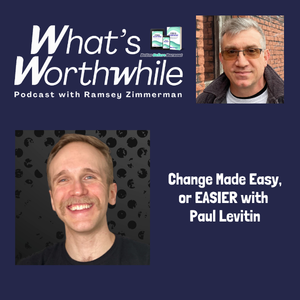
That was Paul Levitin.
Paul is a fitness trainer, a mindset and personal development coach, and the host of the Change Made Easy podcast. But come on, can change ever be made easy?
Well, Paul contends that it can be easier.
In fact, that's his acronym, E A S I E R which he'll talk us through during the episode.
No matter what type of self improvement we're seeking and working on, it requires us to change.
When hearing Paul's approach to making change easy, I found it to be reasonable, encouraging and actionable.
See what you think. Let's jump in.
[00:02:32] Speaker C: Hey Paul, how are you doing today?
[00:02:35] Speaker B: I'm doing excellent, Ramsey. Thank you for asking.
[00:02:38] Speaker C: Yeah, totally. Well, hey, it's great to speak with you again. It was really fun to record with you a couple weeks ago on your podcast, Change Made Easy.
And I just think that's a great topic and great name for a podcast because it's sort of a universal thing that, that change is generally complicated and difficult. And, you know, we'd love to talk to you about how to make change easier, but why don't we start off with, with you. You know, what, what was something, you know, significant major in your life that you felt like you needed to change and that was a real struggle?
[00:03:21] Speaker B: Yeah, that's a good question.
So the impetus behind change made easy, it's been, it's gone through a bunch of iterations, but I've been a coach in various fields. So I started as a personal trainer, nutrition coach, then health and wellness coaching, mindset coaching, all different things. All of those things I feel are very related. They were, each was just the niche, the next natural progression in that train. So it's like, once I understood fitness, it's like, okay, how do I continue to help people? Okay, nutrition, it's like, all right, nutrition and fitness. But like, now I need to understand psychology, now I need to understand behavior and to help people create those changes.
And all of that kind of came from myself finding myself in a position when I was like 27 or 28 years old. I remember pretty, pretty clearly, like I was a personal trainer for about five years. I started, I think, when I was 22, going back, you know, almost two decades now. And I was a personal trainer for about five years. And it was like a good job and I was doing well and I was single and I was like making money and then I was going out and like spending money and drinking and partying and doing all the things you do as a young 20 something guy in the, in New York City was where I was living at the time. And I just remember having this moment of like looking back and being like, I was 27, 28, and looking back and was like, oh, although things are going good, they're the exact same good that they were five years ago. Like, where I am today at 28 is exactly where I was at 23. So then I'm like, well, if I continue that, that means that I'll be in the, in the exact same place again five years from now, which means at 33, I'll be at the same place that I was at 23. And like, that was kind of like an aha. Moment of being like, well, I don't really want that. And then it's, you know, and so I started. It's that that old cliche of like, nothing changes if Nothing changes.
So that's when I started to. There were some other things that also happened in my life around that time, but started to really pour into personal growth, personal development, self help, if you will, that kind of stuff. I was very fortunate in that, as I said, I was already a personal trainer. I was already a nutrition coach. I was already in the world of change.
But this is what caused me to ratchet it up and go into another gear of being like, there's something deeper here. There's. There's something more impactful than just looking a certain way or even performing a certain way when it comes to your body. And there's a mental side of things and a deeper side of things. That. That's where I really started digging into. And then I've spent the ensuing nearly 10 years since that studying human behavior and why we are the way that we are and why we do the things that we do and all the other stuff that comes along with that.
[00:06:00] Speaker C: And what kinds of things have you been studying regarding human behavior?
[00:06:07] Speaker B: So, yeah, I mean, it's a big.
A large umbrella, right? So this is psychology, sociology, behavioral science, behavioral economics. And all of these things kind of combine to answer those questions, like I just said, where why are we the way that we are? Why do we do the things that we do? And one of the bigger questions in my both personal and professional lives is why don't we do the things that we say that we will do? That's always the question that I'm after because again, coming from the space of personal trainer, nutrition coach, people would come to me and be like, I'm going to pay you to help me do this thing. And I'd be like, great, I'll take your money. Here's all the help you need. And then I would watch them over and over and over not do that thing. I would watch people pay for personal training and then not show up or show up in half asset. I would see people pay. I would see people pay for nutrition coaching and then not eat the healthy foods. I would see all these things and same thing, people go to therapy, don't listen to their therapist people. All the things where it's like, what is the disconnect here? Why is it that someone can sit here and tell me, I really want this, I really want this body, I really want this relationship, I really want my whatever to look like this. And then I could go, or anyone could go, a professional or a ChatGPT or Google or anyone could say, here are the exact steps that you need to Take to receive that thing, that thing that you are telling me that you want?
[00:07:25] Speaker C: Well, I mean, I feel like that's a very sort of relatable question. Like, I. I'm certainly guilty of it myself. You know, we all have these great intentions and we have all this, you know, these moments where we really want to make all the changes. But then, you know, life happens. So let's start getting into that. Like, so what do you think it is? Like, what, what does hold us back? I mean, is it, uh, is it momentum? Is it like we're stuck? Is it like we're lazy? Is it like we don't have what we need to change? Like, it could be any or all of those things, but, you know, what do you, what do you think?
[00:08:01] Speaker B: Yeah, so first, I think it's. It's simpler to start with what it's not. And what it's not is not having the information. I think this is where a lot of people stay stuck. There's like, I just don't know what to do. But we have to. I think we have to start with accepting that that's no longer a real answer. Because we live in the age of information.
You know, when I started doing this, this before AI was a thing, but still, Google could answer any question that you had. YouTube has all the answers. Instagram, TikTok, you can find any answer to any question. And now ChatGPT can do it faster and more efficient. So the whole thought process of like, well, I just don't know what to do to achieve X is demonstratively false, right? So whatever your goal is. And again, I use, I use. And this is why also I talk about change, right? This is why it's called Change Made Easy. It's not Fitness made Easy or wealth made Easy. Because all of those things are just change. Everything that you want. If you want something that you don't have, inherently that means something has to change, right? If you want to be in a body that you don't have, if you want a relationship that you don't have, if you want money in your bank account that you don't have, it means by definition, something has to change. So my whole thing is like, the change is the thing that we have to understand. Not so much the fitness part. It's not about, do I eat X, Y and Z to lose weight? It's not, you know, which type of therapy should I do? It's how do I get myself to do that thing? So it's all just change, right? And then you can plug in Whatever change you're trying to make on top of that. So again, first we see that it's not a lack of information that holds any of us back. And we have to admit that because I can do in three hours, if no matter what, any topic in the world, I can become probably a subject matter expert in the course of an afternoon at this point, with the technology that we have, right? So this whole thing of like, well, I just don't know what to do. It's like that's just, you know, get past that right now the question, it now becomes even more juicy because now it's like, well, with all the information, with access to infinite information and the answer to every question that's ever been asked in all of humanity, why is it still not happening? For me, and the answer to this, I think at its simplest is just because it's hard.
We don't like to do hard things and not at a, not at a, not at any conscious level. Like people say all the time, well, I do hard things. I like, I go to the gym and I, I, you know, I have hard conversations with my boss or whatever. We all do hard things, right? But at a genetic DNA level, meaning all life, from human life to the smallest single cell amoeba, follows one rule, which is survive. The point of all life, for most life, it's survive long enough to pass on your DNA. That's really what it is. But rule one is survive, right? So that's everything runs through this filter of is this thing taking me closer to or farther from survival? And every decision runs through that filter. And therefore anything that is challenging, hard, anything that exerts energy falls onto the left side of that, which means it to my brain, to my survival, to my DNA, it feels like it's taking me farther away from survival. And that's something that my brain is going to be less inclined to do than something that is easier, which is saving energy, which is expend, putting myself in less danger.
So now fast forward a billion years to where we are now and we see the discrepancy in that most of the things that we face, if not anything that we face, is really actually putting us in danger. It just feels that way. But still we are, we are caught in this trap where everything that we want to do, that we need to do to receive progress is challenging, is hard, is an ex, is an expense in energy. And everything that our brain wants to do is the exact opposite. It wants to stay safe, it wants to conserve energy. So that discrepancy Right. There is at the crux of everything, of why it's so hard to achieve goals, to make change, to do literally anything worthwhile in life.
[00:11:45] Speaker A: Huh?
Look, we all deal with stress. Stress is not the problem.
The problem is that our body's innate stress response is built for physical challenges instead of the mostly mental, emotional, and virtual stresses that we face today. In my book, Stress Response, you'll learn to manage your response to stress in order to reduce anxiety, avoid burnout, and find calm and steady focus. The ebook is available on Amazon and only 99 cents for a limited time. After you download, please don't forget to leave an honest review and rating so. So that others will find it too.
[00:12:27] Speaker B: Yeah, in my theory.
[00:12:29] Speaker C: No, that's a fascinating theory.
It's so interesting because, I mean, I just see so much irony because a lot of the things that we are trying to do, trying to change, right? Is because we know, at least intellectually, that the things we're trying to change, to do are far better for our survival, right? We're trying to be more successful. We're trying to live longer. We're trying to be more healthy. You know, we're trying to, you know, accomplish things at our job. We're trying to be a good family member.
But yet you're pointing out that at a basic sort of core biological level, our being, our organism, is entrained to try to conserve energy.
But we live in a society now where we don't use enough energy or we don't use our energy wisely. Like, we spend too much time sitting on a chair in front of a screen. You know, we're not actively using energy. So what do you think about all that? Because really, it sounds like we're almost just not using energy effectively, or, you know, our minds think that, or, you know, intellectually we understand that we ought to be using our energy differently towards our own health and success, but we still have this, like, innate momentum around conservation. Like, what. What do you think about any of that?
[00:14:12] Speaker B: So you, you hit, you hit the nail right on the head and that really everything boils down to exactly what you just said. Some people have called it, I've heard it termed evolutionary mismatch. Right? What we have evolved to do and the reality that we live in are at a mismatch. And, and it also brings up the discrepancy of what we logically know to be true is very different than what our bodies want to do. So logically, I can understand that even eating healthy, not smoking cigarettes, going to the gym and watching Less TV are going to make me live longer, more fulfilling and a better life overall. But that's not what our brain cares about. Your brain, again, only again, everything runs through this one direct question. Is this taking me closer to or farther from survival? Not in a, not in a long term view. Right now, today, right now, in this moment, in the next second, your brain cares about survival today, right now. It does not care about survival 10 years from now. Because by definition you can't survive 10 years from now if you don't survive today. So every day it's can I survive right now? And then the next moment is can I survive right now? And then the next moment is can I survive right now? With your brain's hope that that takes you into the future. But also realize that for a billion years of human evolution, the average lifespan was 25 years old or something like that. You know, we, we now have technology, we have all these things. So your brain is not concerned with you living to 70, 80, 90, 100 and beyond. It's, it's concerned with you living right now.
And all of those things that we know to be good for us are painful in the moment. And painful is, is relative. Painful just means it's harder to do it than it is to not do it, right? So not smoking a cigarette does not give me the instant rush of dopamine or oxytocin or whatever else that makes me feel good in that moment. So to my brain, it feels like I'm harming myself.
Skipping a donut in favor for a piece of broccoli in the same way does not give me that rush of happy chemicals.
And it also makes me use my willpower, my finite energy. My brain doesn't like that going to the gym feels hard in the moment. Everything follows the same paradigm. The things that we need to do for ourselves that we know we need to do, that, we say we need to do that. The doctor tells us we need to do that. Our husband, wife, partner, kids tell us we need to do, we know that we need to do all are harder in the moment and pay off down the road. And everything that our body wants to do is the exact opposite. It feels good right now be damned, what it means for us five, ten years down the road. So that again is this inherent paradox. And, and, and when you understand that, it's like, this is why I have so much empathy for people who are stuck or don't, or feel like they're not getting what they want out of life in any regard. It's like because you're not supposed to. You're. The game is built for you to fail. Everything in your body is fighting against everything that you want to do, everything in your brain, everything in your like. So it's like, of course people are like, oh, this is just so hard. Yeah, you're right. That's why my whole thing is change made easy. Not because it's going to be easy, it's always going to be hard. But the way, the only way that I've found to allow people to be successful in the long term. We talk about the big pillars of life. I talk about health, wealth and relationships, and I'm talking about sustainable, lasting change.
So this isn't like I'm going to. I need to work hard on this work project that is due three months from now, right, that has an end date. Okay. Like that you can. That you play by different rules for something like that. I need to lose weight for my wedding so I could look good in pictures or something like that. There's an end date on that. I'm talking about health, wealth, relationships, the things that go on until the day that you die. So that any change that you make needs to continue, right? So people are like, oh, well, I used to go to the gym and then I stopped. It's like, well, then that doesn't matter, does it? Right? It's like, oh, like I was eating really healthy, but then I did stop doing blah, blah, blah. I was meditating every day, but then I stopped. So it's like the way to make those changes stick is to make them so easy that you don't not want to do them, because your body is going to tell you every day, don't do that, don't do that, don't do that. And if every moment you're fighting, fighting, fighting against the thing that you're trying to do, you might get. Get it for a few days, a few weeks, a few months, a few years. I don't know. Depends on your. Depends on your level of willpower, your motivation, lots of different things. But eventually you're just going to stop doing that thing because you can only fight against yourself for so long.
Whereas if you just make the thing easy so it's not so unpalatable, so you actually don't feel that. Ugh, this is so yucky. Ugh, I hate doing this. Oh, my God. Oh, my God. Oh my God. And you're just like, yeah, I mean, I, I don't really go to the gym, but I, I go on long walks with my, with my Wife every day after dinner. And, like, it's the highlight of my day. Well, I don't see you stopping that goal. You go to the gym and you hate it. I do see you stopping that goal.
[00:18:40] Speaker C: Okay, well, I'm just going to ask how the. Do we make change easy?
[00:18:46] Speaker B: Yeah, how do we make change easy? So how do we make change easy? As you said, right? That is the million dollar question and an important distinction. Although the name is Change Made Easy, the framework I use is called easier. Right. Because that's really what we want. Things are never going to be easy. Like I just said, there's always going to be. Everything is going to be hard. Right? Because that's the number one pushback I get when I, when I talk to people. It has to be hard. You go to the gym as hard. Is that, that, that, that analogy of like having diabetes is hard? Going to the gym is hard? Choose your hard. You know that. You see these, these cliches go around Instagram all the time. It's like that. But that's. I'm like, yeah, no, duh. It's always hard. Everything is hard. It's another one of my least favorite cliches, is easier said than done. It's like, yeah, it's easier to talk than it is to do. Of course I can explain everything to you very easily. Actually, doing the thing is the hard thing. So it's always going to be hard, right? So how do we make it easier? And that's. This is a, an acronym, right? E A, S I, E, R.
So E stands for enthusiasm.
Do you want to do the thing?
And if nothing else, you take away from this, you can start and end there. Because that right there decides if you're going to be successful. People all the time go, well, I need to do this diet. Like, well, do you like that diet? Like, well, no, I never want to give up carbs. Like, well, then don't do that thing. Because what you're telling me in not so many words is that eventually you're going to want to stop doing that thing. I remember I was working at a gym and I had a guy came up to me. He was like, he was like, paul, it was in Brooklyn, this old, old school Italian neighborhood. I used to work in the gym. He's like, hey, Paul. Like, I started, I heard about this keto thing. Like, what do you think about that? I was like, well, do you hate bread and pasta? He's like, no, I'm Italian. I love bread. I love pasta. I was like, well, then don't do that because you're going to not want to do it for a long time. And you need to do it for a long time to get the result. Like so enthusiasm. Do you actually want the thing and specifically not do you want the result? Right. This is another big thing, right? People go play, go. Yeah, I do. I want to lose £20. I want to be rich. I want, I want to have the relationship. It's not about.
Are you, can you be enthusiastic about the actions that you take to get there? So not about the end goal of losing weight. Everyone can be enthusiastic about that, Right. I call these magic wand goals. If I could wave a magic wand and give you the result, more money in your bank account, a better physique, better relationship, would you accept it? Of course everyone would.
Huzzah. But we don't live in that world. You have to put in the work to get the result. So can you be enthusiastic about the day to day minutiae of what actually gets you there? Because if you can be enthusiastic, like I said about going for the walk every day after dinner. If you can be enthusiastic about like. Well, actually, yeah, I don't mind just adding a salad every day to, to, to this thing. I don't mind meditating for five minutes if it helps me be better at X, Y and Z. I actually get. I actually look forward to it each day. Okay, great. That seems like something that you're going to stick to.
[00:21:25] Speaker C: Gotta get some joy, at least some joy from the process.
[00:21:28] Speaker B: Right? Or again. Or just be just joy or just feel a positive affect towards it. Yeah. Because if you're feeling everything is negative again, you're fighting against yourself. It's like, yeah, I can do this workout, but I hate it. But I'm gonna do it until I get to X, Y and Z. It's like, okay, but then what happens when you get to X, Y and Z and you stop doing it and you go back to who you were before and you get what you had before, it's like, why even. Right? So that's. E is enthusiasm. A is availability.
Is this available to me, this habit, this change with my current restraints, with the current life that I live? And so the big one is like, oh, well, I want to go to the gym five days a week. I'm like, well, do you have five hours a week to give to the gym? Well, no, I can't because I'm busy at work. I got to take my kids to soccer practice. I got, I probably can only go two or three times a week. I'm like, well then you've just set yourself up for failure before you even started, right? You're trying to. You don't. Maybe in the future that changes and you have more time available to you. Your kids get older, they can drive themselves to soccer practice or something changes, who knows? But right now you don't have that. Or say, they, I want to do this, but I don't have the money. It's like, okay, well then that's a. You're, you're, again, you're fighting yourself the entire time. You can only do that for so long because going back to this is a waste of energy. Your brain will only let you fight against yourself for so long before it, before it decides to quit. This is why everything is self sabotage in a way, because you're only. You can stop you from doing something. But when you set yourself up for a goal that's unattainable either in the short term or the long term, eventually your brain goes, well, I'm not going to keep wasting energy on this thing, so we might as well stop trying now. If you kept trying forever, eventually you would get there. But we don't. We're not allowed to do that. Brain will always say, no, this thing is dumb, right? So E.A. s is straightforward.
Can you tell me in simple language how to get from A to B, B to C, C to D, all the way to Z. Can you explain where you are now and where you're going? Right. The first thing you do when you get in your car to go someplace, you put the address in the gps.
You don't just start driving and hope that the destination appears, right?
And in the same way, if you have a destination and you know what you need to do in a general sense, you can get there even if you don't know the exact route, right? So it's like, if I know if I'm driving from New York to Chicago, I might not know every turn I need to make along the way, but I know that I need to get on this big interstate and then I know that there'll be signs for the next one and then it'll be signs for the next one. I need to have the starting point and the ending point and a general direction, right? Because things change.
There's the analogy that, you know, if you're driving through a really dense fog, you can only see 10ft in front of the car.
But you can drive a thousand miles like that because every time you drive 10ft, the next 10ft reveals itself and you drive 10ft, and the next 10ft reveals itself. So you don't have to stop driving. You don't pull over to the side of the road because there's fog. Somehow you just keep driving through the fog. And since you know the direction you're going, you have an end destination in mind. You, you, you figure it out on the way. But you need to be able to explain what that end destination is and what are the broad strokes of what will get you there. Because otherwise, like I said, your brain will tell you to.
[00:24:42] Speaker A: Here on what's worthwhile. We've spoken a lot about burnout and why it's important to avoid it. So now let's talk about burnout resilience. Burnout resilience is your capacity to handle stress without losing your clarity, your energy, or your sense of purpose.
[00:24:56] Speaker C: Purpose.
[00:24:57] Speaker A: It is the ability to recover well, stay steady under pressure, and keep moving forward when life gets demanding. And the good news is it can be built by strengthening the foundations of holistic health. I created the burnout Resilience Zone assessment to help you see where you stand and which foundations may need attention. It takes just a few minutes and gives you a personalized breakdown with clear recommendations.
Go to burnout.whatsworthwhile.net and learn which zone your burnout resilience is in.
[00:25:29] Speaker C: So we've got enthusiasm, availability, simple.
You know, those three sort of. The first half, what I see you sort of framing up is a. Is a framework that is very realistic. First of all, we're going to keep going. But it just, it struck me that, you know, you have to kind of be excited about the process as you're going. You have to be realistic about what you can actually do, and you have to know what it is that you're setting out to accomplish. So that's the first three. Enthusiasm, availability, and simple.
And so what's the next one? What's I?
[00:26:13] Speaker B: So I is imperfect, right? So perfection. People talk about this a lot is perfection is the killer of dreams. Perfection is an impossible, unattainable ideal. We know that when someone is holding themselves back, often it's perfectionism, right? It's like, oh, well, I can't do it because I can't do it perfectly. Or they don't even say it in those words. But that is what it is. I recently had a client who messaged me. He's like, oh, man, I haven't been showing up for our calls because things are kind of sloppy right now. And I just feel bad when that happens. And I'm like, there's A word for that, you know, perfectionism, because you only want to show up when you have something good to report. When you have something good to good to tell me, I'm like, but the whole point is the opposite, because if you were perfect all the time, everything would have already worked out. So for imperfection, it's not just understanding that perfection is impossible. We go a step further and we say, we lean into imperfection, we search for it. Because when you mess up, when you are in the muck, in the mess, that's when all the good stuff happens. If you went to the gym and you only ever lifted weights that you could lift, you would never get stronger. If you did Sudoku puzzles, but did the kids book all the time, your brain wouldn't get any better. You would get bored. So it is literally the act of being imperfect, of being okay with being ugly, being messy, that allows you to progress. So that, that, that's the action is leaning into imperfection and being not only. Not only being okay with it, but actually searching for it because of how powerful it is. So that's E, A, S, I. Yeah,
[00:27:40] Speaker C: you're never going to get it right
[00:27:41] Speaker B: the first time or maybe the hundreds. But being okay, right.
Again, there's no, there's no such thing. Perfection is not the goal. That's the thing, right? It's like, I don't want to set you up because even if you could be perfect at something for a time, again, we're talking about lifetime goals. Like I said. If you're talking about a project that has to be released, this has to be perfect before it goes to market. Maybe that's worth chasing perfection on. But what you're just talking about life, health, wealth, relationships being a little bit better. That is not. It's not a static thing. It's living and breathing. And you're fighting against the universe, which is entropy, which is chaos. So therefore you're trying to hold something perfect, pristine, this perfect little snow globe in a world of tornadoes and hurricanes. And it's like it would be so much easier if you just allowed yourself to go through life and live right? And that, you know, in that search for imperfection, you actually ironically find usually perfection in some, in some sense.
So that's E, A, S, I. The second E is exponential.
This is a big one. So exponential means going back to again. Rule one, right? What did I say? That you have to. It's all about trade offs. Does this thing get me closer to or farther from survival? So it's all about an exchange of Energy, right? If I spend more energy than I take in, that to my brain, to my body feels like debt, right? That's a death sentence. If I'm spending 10 energy and only getting back 5, that means that I'm going to be depleted in energy, and therefore I cannot keep doing that thing. By definition, my brain goes, this is an impossible. I can't keep making this trade forever.
So to make myself be able to do something over and over for as long as I need, I need to flip that switch and stack the deck for the benefits to be greater than the outlay of energy.
So, you know, again, using the gym as an example, people always go, you know that working out is really good for your mind, too. It's like an antidepressant, right, that gets thrown around all the time. It's like, whoa. It's good for your body and it's good for your mind. And yet we know that 80% of Americans don't even have a gym membership, but 70% are overweight and obese. So, like, if it were that simple. Oh, two good things. Well, it's just the gym, but you get two good things. It's like, no, you need more because the gym is hard and it sucks and it costs money, and it's a half hour from my house and I'm tired and I don't want to do it. And you have all these reasons not to do it. So therefore, being healthier, losing weight, it feeling good.
That deck is stacked 10 to 3, right? I'm holding up my fingers for people just listening, but it's like, I need to continue to list off potential benefits until the potential benefits so far outweigh the potential cost that it would be ludicrous for me to not do this thing right? So I like to ride my bike, whatever city that I'm in. I, you know, I have a car, but I try to ride my bike for whatever reason. It's like, you know, riding your bike is healthier. It's better for the environment. It's okay. But, like, it also maybe is hard to do because I get tired if I have to ride more than like, five miles or something like that. And, like, it's. I'm sweaty when I get places, right? So, like, those things cancel each other out. It's like, okay, but it's healthier for me. I get my cardio in before I actually have to do anything. I save time because often in big cities, it's actually faster for me to meet, for me to get. Get around on my bike than it is for me to get around in a car. I don't have to wait for lights or anything like that. I save money on gas. It's better for the environment.
I get to listen to podcasts while I go. Sometimes I can listen to music. I get sun on my face. We all know how important it is to get some sun. Fine, right? So I'm just like, stacking, stacking, stacking, and I'm just listing out these things to where. Now it gets to the point of being like, huh, Riding my bike seems like the logical decision. And it seems like to not do it would be pretty silly of me because look at all these benefits that I just listed. It's an exponential payoff. Like, yes, there is a cost, but the cost is so minuscule compared to what I get in return. It's like the only thing that makes logical sense to me is to do that thing, right? So you have to stack those benefits, stack those wins. That's E for exponential. E, A, S, I, E. And the last piece, the R in easier stands for repeatable.
Repeatable. Can I do this thing forever? That's, that's the, the rubric that I live by. So if you say, oh, man, I'm doing this really hard workout routine, and I go, how do you like it? They're like, oh, it's great. I feel great. Like, how long do you think you can keep that up for? Well, I'm already pretty tired. And, like, I probably this week, next week I'm gonna need to take. It's like, all right, well, why are you telling me this? Right? Like, I'm doing this diet. I, I, I cut out all carbs and all this, and I'm losing weight. I'm like, well, are you never going to eat carbs again? Like, well, no, I probably will eventually. It's like, okay, so then what are, what are we even talking about here, right? It's like, can I do this thing forever? Because as I said earlier, if I can't do it forever, that means I'm going to go back to what I was doing before.
[00:32:24] Speaker C: So that is quite a framework.
Easier.
So enthusiasm, you have to be excited about. And, you know, in it, for the process itself, availability, it has to, you know, you have to be actually able to do the things. You have to have the resources to do the things simple. You have to be able to say it out loud, know what the destination is.
Imperfect. It has to. You have to sort of embrace the fact that when you do new stuff, you don't do it right like perfectly and like maybe ever exponential.
You have to stack all the benefits on top of each other because you have to overwhelmingly outweigh the costs and repeatable that you have to be able to click through and do it forever.
There is just an absolute ton packed into that.
It strikes me. A couple things strike me.
I think it's really interesting in the.
So this with your repeatable step.
What about the, you know, are there times where we certainly are going to be, you know, climbing a steeper hill than other times?
Because you know, there's certain steps in any process where you know, you're really striving for a certain thing or you're setting up a time where you're trying to achieve a certain goal. But you know, the way that you described it almost felt like you were sort of not talking about that. So. But are there times where you push something harder towards a, an intermediate goal, knowing that it's not gonna be forever?
[00:34:11] Speaker B: Yeah, of course, right. Everything that, you know, nothing covers everything all the time, right. This is in a general sense, I use this to talk about habits and things in our life that we want to instill forever. Right. So there's a time where, like I said, work projects or certain things or again, maybe you're just like you're starting at the gym. There's a. The world again. I've worked with lots of people to, to lose weight. And one of the things that we know and studies have shown us this is that like the best thing to do is to start people off win. It gets people, it gets buy in. So there is a world where you just do stuff to get them losing weight in the beginning, even though you know that's not sustainable in the long run because it gets them to mentally check in what they're doing.
I think, of course those things happen, right? You, you need to. There are times when it's not going to be sustainable for the long term. But you have to separate the goals and understand which is everything is a tool in your tool belt. And if all you have is a hammer, everything is a nail. But if you have the right tool at the right time and then you have the right thing. So when I talk about again, changing relationships, the relationship I have with my partner or with my family, when I talk about my, my financial well being, these are not goals that shut off like there, there, there's the time for like just white knuckling, just shutting up and just like, yeah, sometimes you just gotta nut up and just do the thing. Right. Like, of course that happens. With time. But those are a different type of goal. Again, those goals often have time limits on them. So it's like, okay, I have to, I have to get this result by this time.
[00:35:33] Speaker C: Yeah.
[00:35:35] Speaker B: Often mistakenly, these are time limits can be self imposed. Right. I have to be this weight by summer. Like that's not a real thing. You created that thing. Right. So that's what I mean. Where it's like now you're going to use. Because you've imposed a false time restriction, you're going to use tactics to get there that aren't sustainable. Right. So if I say it's, you know, we're in March right now recording this, if I'm like, oh well, I got to be this body type by June now there's only a few months till then I'm going to have to do something that is very unsustainable to get there. Because that's just the nature of what I'm, what I'm asking of myself. And therefore I know as a practitioner or someone who's done this with many people, it's like even if you got there, you're not going to keep it and you're going to backslide. So it's like that, that, that to me is very different. But as you said, there's times when, yes, you, there's. It's not something that I want forever. It's something that I'm just doing this for the. Right now I'm in a building phase and that's okay. That's a different set of rules for. Cool. Yeah.
[00:36:28] Speaker C: Yeah.
Another thing that really struck me is when you're looking at those, that exponential step where you're sort of stacking all those benefits on top of each other.
That felt to me like a very intellectual step. Like that was a mental step.
A lot of the stuff that we've talked about today are, you know, physiological sort of demands of our survival. But is that sort of the step where like our mind is using, trying to use overwhelming force to like override our physiological survival needs?
[00:37:06] Speaker B: Yeah, basically. Like so, you know, you can think of it as again, you are at odds with your physiological survival needs. Some people call this the lizard brain or the monkey mind. And it is a literal battle between what our subconscious lower level thinking that keeps us safe, needs or wants and what we know as the more evolved being. Right. That we know that the, our brain has evolved in stages. Right. So that lizard lower level brain, that's what kept us since we were tree humans. And the part of our brain that allows us to think logically is the last piece that, that has evolved in, in terms of evolution. It's a couple hundred thousand years old maybe, but still in, in the terms of evolution, that's a brand new thing. So some people have termed it like the, the rider and the elephant. Right. The elephant is the, the big subconscious. It's the most powerful and it will bo down and then the rider is on top of it and the rider can direct the elephant. But if the elephant really wants to, it could kill the rider and it doesn't need to take the orders of the rider. So the rider is trying to direct the elephant where to go. But realize that the elephant truly has the power. It's just the rider is trying to show it what's right and what's wrong and what it needs to happen. So that is exactly what we're doing with the exponential pieces. We're trying to literally trick ourselves into doing the thing that as you said earlier, we know to be beneficial in the long run. We know that doing this thing would be better for us if we could just get ourselves to keep doing it. And this is the one of the tricks that we can use to serve that pursuit.
[00:38:31] Speaker C: Yeah. You know, we've talked a lot about why it's difficult to change as a person within ourselves and we've talked a lot about the sort of difficulties that our body or our physiology, physiology proposed to us. But what about things like societal pressure? What about like peer pressure? What about like the desire to either follow the crowd or stand out in the crowd? Like what do you think about those things? Because I think that that external pressure also makes change difficult in a variety of ways.
[00:39:16] Speaker B: Well, so there's two, two pieces. The societal change is completely different. I'm going to leave that to the side for a second. But in terms of peer pressure and like how we, how we pro, how we present to others and things like that, realize that all of that is still the same thing. It's survival. Right. Because to our survival brain ostrac being ostracized. Ostracization being ostracized from the, from the crowd is a death sentence. Right? Yeah. We were, we were, we were evolved in hunter gatherer tribes of a hundred or less. And in that for most of human civilization to be banished from the tribe is tantamount to death.
Right. So if you, if you're trying that and there, that's why we feel shame is so powerful in us because in our DNA it feels like I'm going to die if these people don't like me. This is why public speaking is the number one fear that most people have. So it's the same thing. It's your brain going, this thing is going to kill us. Even though I might know that logically asking that girl out or that guy out or raising my hand in a, in a, in a meeting and having it my idea shot down or a million other things actually won't hurt me and probably would make me better in the long run because we've all heard of those, like get a thousand no challenges or something like that, or every no is one step closer to a yes. But in my body, it feels like physical pain. It feels like I'm not going to survive this. It feels like all of the same stuff. So it follows the same rules because our brain is just going like, this isn't good, and we have to somehow logically push it in the other direction.
[00:40:48] Speaker C: So then the, you know, the, the result of that, of the external pressure is very similar to the result of the internal pressure because it, just because the external pressure gets translated into the internal pressure is kind of what I'm hearing from you.
[00:41:08] Speaker B: Yeah, I mean, it can actually almost be worse because the external pressure is oftentimes we look at it more harshly.
[00:41:16] Speaker C: Well, I have to say this was
[00:41:20] Speaker A: a really great conversation.
[00:41:21] Speaker C: You have a very structured and comprehensive way of looking at things, while at the same time you put things across really clearly and really sort of in a very straightforward, realistic manner.
So, Paul, tell us again about your podcast, where we can find that, where we can find you online, all that good stuff.
[00:41:51] Speaker B: Yeah, my podcast is Change Made Easy. Change Made Easy on any place that you find podcasts. Ramsey was recently a guest, so that episode might be up by the time this one is. But he'll be up there soon if he hasn't already.
And on social media, it's super simple. It's just my name, Paul Levitin, on all platforms again. My whole thing is how can I make this as easy as possible for people? So nothing complicated, but I don't have anything to sell you. I don't have anything to do for you. I, I, I, I'm filled up for coaching. I couldn't be a thing. The one thing I want for people is to go listen to the podcast. I have over 400 episodes of Conversations a lot like this one. Helping people through change, with habits, routines, things that will be actionable right away. That's what I'm all about. So go listen to the podcast. It's completely free. I truly believe it can change your life.
[00:42:38] Speaker C: That is so fantastic. Thank you so much. It was fun talking to you again today and really appreciate it.
[00:42:46] Speaker B: Thank you so much for having me. I really enjoyed this conversation. Yep.
[00:42:50] Speaker A: Ready for more? Visit whatsworthwhile.net to listen to podcast episodes. Master your response to stress by reading my book, Stress Response, available through Amazon, or to get better before burnout sets in by requesting the free guide. Regardless of where you are in your journey, I'd love to hear from you and talk about how we might move forward together. Please contact me, Ramsey Zimmerman through the website or on social media like Instagram, Facebook, LinkedIn, or X. Thanks.
[00:43:27] Speaker B: Ra.