Episode Transcript
[00:00:11] Speaker A: What's worthwhile considering what we consume, believe, say and do towards peace of mind,
[00:00:18] Speaker B: vitality of body and joy of spirit.
[00:00:22] Speaker A: I'm Ramsey Zimmerman. Here's some more healthy living motivation and discussion.
[00:00:31] Speaker C: You know, and I find this especially for certain types of men that are very driven, very focused, very disciplined in all parts of their life. And then when they learn about nutrition, right, then they turn that into another self improvement project, you know, and then they dial in everything. But it's like that's like basically giving your strategic eater total control over what's happening and often then neglecting or even exiling, right? The pleasure eater that says, oh, like I want something just because it tastes really good. Or the social eater that says, well, we should think about what other people are eating and how we get to connect, right?
So there's a million ways in which this family of inner eaters can, can kind of go awry.
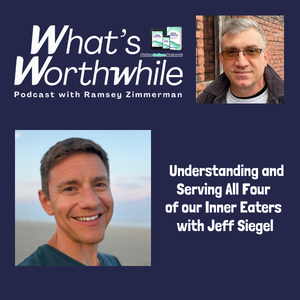
[00:01:13] Speaker A: Hey there, it's Ramsay here. That was Jeff Segal. Jeff is a men's wellness coach and helps high performing men transform their relationship with food, their bodies and their identities.
He's also a Harvard teaching fellow and the Author of Eating 2.0 how to Eat Confidently in an Ultra Processed World. In his book, he eloquently describes our family of four inner eaters who have very different and often competing interests, namely survival, pleasure, socializing and strategy.
We talked about how he struggled with anorexia as a teenager, how disordered eating often manifests differently for men than women, and how to help all of our inner eaters get along with each other and share their time at the table.
I thought this was a great discussion and a different take on eating healthy. Let's dig in.
[00:02:13] Speaker B: Hey Jeff, how are you doing today?
[00:02:16] Speaker C: Hey Ramsey. I'm very happy to be here.
[00:02:19] Speaker B: Well, good. I'm happy to have you here too.
You know, it's going to be a fun one, I think, for me because you have a lot to say about eating and that is something that I'm very interested in just, you know, generally as a pastime, but also because it's one of the four things that I think people can really reasonably have a level of control over in their lives to sort of improve their health. And I think of those as waking, eating, moving and sleeping. Not to say that it's easy to do and control all of those things, but I think we can relatively be able to do those.
So we're going to talk all about eating today, but first, I would definitely love to hear more about you.
I know that you are a Men's wellness coach and a Harvard teaching fellow and an author.
Why don't you start off by telling us what was your relationship with food early in life and why and how is it that you eventually came to focus on eating in your work?
[00:03:40] Speaker C: When I was about 14, I left my kind of small, wonderful little elementary school and moved into a new high school. And like I think most teenagers, was disoriented by being a freshman in a new social world at that time. My brother, I have an older brother who also just kind of left to go off for college. My father was starting to get very busy with his work, so he wasn't around as much. So there was a lot of transition in my life, right? There was a kind of a vacuum of family that I was used to, especially in men in my life.
I was in a new social world and new school, and I think there was a part of me that was grasping for control, right? Like, like so many of us, right? When we're faced with a world that seems so unpredictable, you know, so ambiguous, like, you know, I feel like that's very much the world we're living in these days. You know, we. We find ways to create some sense of safety or control. And I think for me, that ended up being with food. And what started as, I think, you know, a fairly innocent way of kind of reading nutrition labels and counting calories slowly but surely developed into a full blown eating disorder. You know, where there was a part of my mind that was so negative, so rigid, so controlling, really bent on perfection, which said I could only eat this number of calories at this point in time with these types of foods.
And it really destroyed my life and at every level because I couldn't go out and eat with friends.
Meals with family were so tense and awkward.
You know, my father tells a story of remembering we were at some place one time and walking, you know, there was a buffet and I was so overwhelmed by the food, I just. I just froze and sat on my seat like I couldn't even do anything. I was paralyzed, right? Like, it was that degree of problems. And then I almost starved myself to death. So it was a very dire situation.
I had to leave high school, enter into a residential hospital program, and thankfully, I was able to pull myself out, right? All along, there was a part of me that truly wanted to be healthy, a part of me that believed that I could be well. And I had to tap into that part and really grow it. And thankfully, with the support of my family, the support of a lot of professional therapeutic Help and probably some guidance from beyond in the spiritual realm. I was able to kind of dig myself out of this hole and took years, probably decades, you know, to get me to a place where I now have a, you know, a healthy relationship with food, a healthy relationship with my body. And that is really at the center of the work that I do today.
[00:06:35] Speaker B: Yeah, well, thank you for sharing all of that.
Do you think, or rather, how do you think that disordered eating often manifests for men sort of differently than for women? Because what you're describing is, you know, a personal experience, but I think it's an experience that lots of people share.
I've heard, you know, and spoken with several women about that, but I'm not sure I've spoken, spoken with too many men with that experience, but I can absolutely see it.
How do you think that it sort of manifests differently for boys and men than it does for women and girls?
[00:07:27] Speaker C: I was definitely an outlier as a man with anorexia, and I think I was maybe one of two men that were in this eating disorder program.
You know, and the common cultural quip, right, is like eating disorders are a teenage girl thing or a wealthy white woman thing, you know, and there is almost no acknowledgment that there are actually many men that suffer from eating disorders. I think it's actually dramatically under diagnosed and for a number of reasons. One, because it doesn't always look like.
Right, like a starving person.
You know, I think for men, the disordered parts around eating can happen more around a body image. Dysmorphia muscle. Dysmorphia. That's kind of bigorexia, right? Where you're. You're never lean enough or big enough.
Or it can manifest more in that binge eating part, which is often hidden. You know, I know some guys that, you know, kind of look relatively normal and eat relatively normal, but you never know that, you know, they're hiding in their car, scrapping down an entire pizza, or they're at the gas station, you know, eating bags of candy.
And so there's these sort of ways in which the disordered eating, I think, in men is a little bit more hidden. And then also, you know, classically, I think a lot of guys have a hard time asking for help, reaching out for support, or even admitting that something really is dramatically wrong. And because of all of that, you know, I find that, you know, eating challenges in men tend to be a little bit more stealthy, but they do exist. And a lot of the guys that I work with are Dealing with some form of that. And again, there's a whole spectrum. You know, I was very much on one end, like, you know, this is a severe clinical problem, but, you know, on the other end, there's ways in which eating can become disordered where it's just not working for you. It's not working for your body. Maybe it's causing some health issues. It's not working for your relationships. Maybe it's causing some friction in your family or marriage or. Or just this causing your own internal sense of like, you're never at peace with food because you're always fighting, right? It's like everything is like you're either good, bad, winning, losing, failing, and just creates so much dissatisfaction. And I think when you can begin to heal that, right? And then that really opens up a just a much more peaceful relationship with. With eating, which is something I think we all deserve to have.
[00:09:54] Speaker B: And how did you begin to climb out of that hole and heal and get better and improve your relationship with food?
[00:10:09] Speaker C: You know, I wish I could point to a single thing, but it's often not just one thing, you know, something I come back to, right. There's.
It's great to have a toolkit of different practices. You need an ecology of, you know, things to resort towards. And I think I was.
Luckily I had a healthy ecology to tap into.
That was parents that were caring, attentive, and resourced enough to send me to some expensive program to get better healthcare that was able to pay for a nutritionist and a psychologist to work on that.
Books. I read a bunch of books.
I forget the exact titles even when I was a teenager, but I think all of that stemmed from. There was a part of me that truly wanted to be healthy. And I felt like I was battling this eating disorder.
On one sense, it was crazy. Like, it was crazy that I. I couldn't, you know, eat a piece of chicken unless it had been perfectly portioned, right? Like, I mean, it's like I could see the absurdity into. In it, but at a certain point, and I think this is true with a lot of mental health issues or addictions and different substance use, like you. You become powerless.
And then. And you know, there was a time where I felt powerless.
And I think so, you know, and I think this is often true, you hear, with maybe alcoholics. It was that moment when I admitted that I was powerless and that I truly needed help and that I couldn't do this on my own.
That I think was really the beginning point of my recovery. And for me, that Happened sitting on the couch with my mother as a teenager.
But there were many, obviously supports along the way, you know, people that helped guide me and really just helped heal. What I see is sort of, you know, it was like a civil war of my mind and my body coming back together. And now I'm like, well, recognizing we're actually on the same team.
[00:12:04] Speaker B: Yeah. Yeah.
Well, I think, you know, many people have issues with their eating and people feel conflicted about eating.
People have a love hate relationship with food sometimes.
You fast forward quite a few years. You've written a book, Eating 2.0, and in that you describe pretty eloquently four different types of inner eaters. And I really like that model because I think it really kind of sums up the experiences that we as people have with eating. So I'd love to take some time and kind of go through each of those four and would love to hear kind of what those inner eaters are trying to accomplish, you know, what they're driven by and how they're different. So can you list the four for us and go ahead and start with whichever one makes the most sense to you and then we'll talk about each of them individually?
[00:13:11] Speaker C: Yeah, absolutely.
So these four inner eaters are really at the core of my book Eating 2.0, and they are the survival eater that is really trying to protect your body, your homeostatic balance. And its gift is that it does all of this sophisticated energy accounting for you, and it will make sure that you get all of the nutrients that you need and all the energy you need to stay alive.
The shadow is that it's kind of opportunistic. It doesn't really care about so much what it is you're eating. It just cares like, is there enough food? Am I starving? Am I being deprived or not? And obviously in a world of super abundance that we often live in in modern America, that can kind of get the best of us when we're always running on that survival mode.
The second one is the pleasure eater.
And this is the part of us that's really trying to protect the sense of joy and enthusiasm.
The fun of food and its gifts are that it gives us this ability to slow down and savor, to really take in the senses, the smells, the textures, to really truly enjoy the experience of eating.
The shadow side is that this can be hijacked by modern kind of ultra processed franken foods that are formulated to get the best of us to over to put our kind of, you know, reward centers on overdrive, right? To create that kind of dopamine, you know, hedonic craving loop. And this can lead to overeating. It can lead to kind of addictive, like, patterns with certain foods.
And then the third one is our social eater. And this is the part of us that's trying to protect that sense of connection, right? Like so much of food throughout all of human history has been, you know, about being together with others, right? Food was safety within our tribe. Food was a way in which we formed connections with other people, right? We prepared foods together. I mean, most of our lives is oriented around growing food and eating together. You know, rarely, I think, for most of human history do people really eat alone the way we do today.
And so it's gifts is having that sense of a shared meal where there's some coherence of like, we're doing this together even if we're not even eating the same exact things.
There's a social connection to it. There's a sense of belonging.
But the shadow side is that we can sometimes lose our own sense of what we need. What does our body truly need in that moment? Because we are just going along with the group, you know, and in a modern context, it's like, you know, when you have a lactose sensitivity or gluten sensitivity and everybody's like, let's order pizza. And you're like, sure. And this is going to make me feel like crap, right?
So we need to learn how to balance those pieces.
And then the last one is what I call the strategic eater. And this is the part of us that's really trying to protect more of those long term goals that we have. And those goals can be more sort of aesthetic or vanity in terms of how our body physically looks. They can be more geared towards health and longevity or just maintaining good vitality, or those goals can also be more geared towards the ethics of eating, right? Like, is this an environmentally responsible choice, which I think is really, really important nowadays to be thinking through that lens.
But there is the shadow side of the strategic eater, which is what I call this macronutrient micromanagement, which is, you know, when we are so caught up in this obsession with, you know, calculating the perfect meals and making sure that we're getting exactly the right grams of protein, or if we don't have enough fiber, then we freak out, right? And so this can really dip into, you know, that disordered place where it's like what starts as maybe a useful sort of discipline around food can metastasize into this really unhealthy, rigid way of eating, and that can be the shadow of the strategic eater. So I like to say all four of these are present within all of us, but we tend to default to one or two of these perspectives when it comes to our relationship with food, and none are good or bad. Right. As I said, each one has gifts, each one has vulnerabilities, and when you can see them, you don't have to be them. I think this is really the important move I'm trying to help people make in my book, is that when you can see these four eaters, you don't have to be them. You can actually step back. And then it is now a choice of, do I want to lean into my pleasure eater because this. This food was prepared really well with a lot of attention to the flavors, or do I want to lean into my social eater because I'm at a special celebratory meal with a bunch of friends, or do I want to lean into my strategic eater because I'm really trying to kind of dial in certain things for my health and be more, you know, rigorous about that. Right. So it's like all of these now become a choice, and we have this flexibility in how we manage that. This is a higher level and a more sophisticated way of approaching food. And that is that upgrade that I am talking about from an eating 1.0 to an eating 2.0, which is hence the title of the book.
[00:18:32] Speaker B: Yeah.
Well, I think that's a really terrific model.
And, you know, we eat for multiple reasons, and we have, you know, a physiological need to eat, Our bodies need energy.
But then we also eat because we enjoy it and we eat with others. And I just enjoy. I really like how your model sort of weaves those together in different ways.
You know, looking at that survival eater, I think when things like blood sugar crashes kick in, then that's when your survival eater probably comes in really strong.
But then, you know, that can be manipulated.
[00:19:26] Speaker C: Absolutely.
[00:19:27] Speaker B: The foods that you eat, the messages that you get, They will sort of mess with or alter your physiological system of even what survival is. Or, you know, in terms of is it really a matter of survival or not?
And then when I look at, you know, the pleasure eater and the social eater, those are both sort of enjoying good food with good people, but they're. They're connected, but they're different because sometimes maybe you're enjoying that food just for yourself, maybe.
But maybe in other cases, they.
You're enjoying it with other people.
And then this.
Your idea of a strategic eater is almost like the flip the, the other side of the coin of survival. It's like when you're in sort of your best mind, your best place, and you can sort of think all the way ahead, you can be strategic about how you eat.
I wonder, it makes me wonder if, like, how these are connected in your mind. Like, do they fall into a sort of a neat picture where perhaps they're on a matrix or across from each other or connected to each other. Like, tell me more about how they interconnect.
[00:21:02] Speaker C: It's a great question, Ramsey, and I appreciate you kind of like naming out, right? Like how you see these four parts showing up for you. And this is what I say to everybody listening.
What I'm describing are kind of the core four patterns that I have seen in people's relationship to food. And they're kind of almost like archetypes, but they're going to manifest, they're going to show up differently for each one of you. And so it's important to start this process of just self observation of like, yeah, oh, how does my pleasure eater show up? When does my survival eater show up? Is it because I skipped lunch and I'm really, really hungry? Or as your point, is it because there's this false sense of scarcity? The foods that I'm eating are actually nutrient poor and my body is screaming out for some real, you know, sustenance. But, and so to your point of like, how do they all get along or not get along, right? Like, well, I often refer to them as a family.
And like every family, right? I mean, there can be good times and there could be bad times, right? Like, some families are a little bit more dysfunctional than others, you know, or, you know, if I love the movie Inside Out, I don't know if you've, you know, it's a wonderful movie. So a lot of times, you know, I tell people, I'm like, you know, think about these four inner eaters similar to the characters in the movie Inside out, right? It's like, and if you want to kind of go down the cartoonish, you know, homunculus route, right? So you can imagine these, these four people, like, you know, sitting somewhere in your head or maybe in your stomach, right? They're around the control panel and they're just kind of arguing and they're fighting, like, who's getting control, right? Like, are you going to put that on? You're going to plate? Are you going to eat that thing? Are you going to order that dish? Right?
And sometimes there's a sense of order, which I Think it's like again, each one of these is giving their gifts to your eating and that would be an orderly experience that's very functional. But then it can also be very disorderly where, you know, one part is trying to take over control. And I see this often, you know, with the strategic eater where it can be very overdeveloped. That kind of goes back to that rigidity.
What was sometimes referred to as like orthorexia, which is that, you know, obsession with healthy eating, you know, you know, and I find this especially for certain types of men that are very driven, very focused, very disciplined in all parts of their life. And then when they learn about nutrition, right, then they turn that into another self improvement project and then they dial in everything. But it's like that's like basically giving your strategic eater total control over what's happening and often then neglecting or even exiling. Right. The pleasure eater that says, oh, I want something just because it tastes really good, or the social eater that says, well, we should think about what other people are eating and how we can connect. Right.
So there's a million ways in which this family of inner eaters can kind of go awry. And in my book I have a few chapters dedicated to those interactions and what you can do, some specific kind of protocols and approaches to try to get them to work together. And I think this is where I take the position of leadership. Again, your job is not to control them, but if you want to step in.
[00:24:13] Speaker B: Yeah, well, yeah, I was going to ask, you know, what are some of the things you can do if you're, you know, family of eaters don't get along and you, you know, find that you have more arguments inside your head about eating than clear pathways. What are some sort of strategies for, you know, getting them all on the, on the same page or the same plate, if you will.
[00:24:41] Speaker C: Yeah.
So the first step is like differentiation, Right. You need to separate yourself enough from that one inner eater perspective to see it clearly.
Because if you're just trapped in that survival eater mode or it's just like I'm ravenous and I'm just going to eat anything and I don't really care, then it doesn't really matter. So you kind of have to get yourself out of that so you can begin to see all of these parts in action, then the second part is kind of softening that shadow or whatever those vulnerabilities of that eater are, you know, taking some responsibility to, to mitigate that and get, if we're talking about the Survival eater, you mentioned, you know, blood sugar dips. Well, it's like, you know, if you're eating a lot of, you know, sugars and highly refined carbs, you know, constantly through the day, or if you're insulin resistant, as many of us are, if you're highly sedentary, right. There's a number of things that might keep you on this blood sugar roller coaster, which is certainly going to affect your mood, your hunger, your energy. So this is making some adjustments so that you know that survival eater isn't so extreme, isn't so erratic. That helps kind of bring it back to more of a baseline place where you can work with them. So it's like, I think the first step is to kind of work with an individual eater to try to help it return to some sense of normalcy. Then we can work with the interactions.
And this is back to this idea of leadership, right? Like inner leadership.
Take the seat at the head of your own table, right? Where you're not suppressing any of these inner eaters. You're not shaming them or blaming them. You are leading them like a good leader or like a good coach, helping them show up as best as they can, right? And it's not perfect, you know, and another way, if you want to think about it, is like being a good parent, right, to this, this family, you know, and it's like if you have a bunch of kids and any parents out there know, right? Like, it can. It can be chaotic, it can be hard to satisfy everyone's needs, and not everybody is going to get what they want all of the time, but you find ways to make it work. And I think the same thing is true with our own desires on the inside.
And one thing I keep coming back to is having a really clear vision, a bigger, better offer.
It's like when you can really get this clear vision of, hey, this is who I am and this is what I want. And this is what I want not just from my eating, but for my eating, you know, because again, we're all on the same team, then we can begin to recruit these different parts of ourselves into this. Of like, yeah, you know, it's like I want my eating to both feel good in the moment, but also not compromise my ability to feel great tomorrow. And I want to be able to eat in a way that, you know, has a certain degree of kind of predictability and structure, but also is flexible enough to bend and flow with my life in the moment.
And ultimately, it's like this living relationship that is going to Be able to grow with me over the years and the decades to come.
[00:27:40] Speaker A: And
[00:27:43] Speaker B: what about for someone who hears this and just thinks that they're missing one of these inner eaters or that, you know, they had such an experience that maybe they, I think you said exiled or destroyed one of these eaters kind of years ago. What, what kind of advice do you have about, you know, re finding that like, like an example that hops to mind is someone who just no longer gets any pleasure or joy or enthusiasm from food because they had such a terrible experience with food previously? Yeah, that's just one example of many. Like what, what kind of advice do you have for people to, you know, rediscover reconcile with an inner eater who may have been, you know, cast aside?
[00:28:37] Speaker C: Yeah, I love that question. So I'll give you two examples.
The first one will be a personal one, right. As part of my eating disorder, I would say my, you know, I had a very over developed, strategic eater. And, and I think my pleasure eater got really banished, you know, was, was so hyper controlled or, you know, food reward had to be earned, had to be doled out, had to be won in all these particular ways just to get a bite of anything that tasted good.
And I healed a lot of that, you know, growing up. But there was always one remaining vestige of that, which was like around desserts. And even as an adult, you know, for many years, I never ate any dessert. Like, I just couldn't wrap my head around it. I'm like, why would I throw extra sugar and fat into my system? Like metabolically, this makes no sense. I've just had a full meal. But what I never really was appreciating was that, yeah, dessert, sure, metabolically doesn't make sense. But from a social eater perspective, when your family is engaging in this ritual, like, there's a connection there. From a pleasure eater perspective, there are certainly plenty of wonderful pleasures and textures and tastes to be enjoyed.
And even perhaps I'm a survival eater, depending on what I've eaten earlier in the day, how that kind of fits into my body's energy balance.
So I had to really relearn how to engage my pleasure eater. And there was a turning point for me becoming a father when I really, really wanted to make sure that I was not passing on any sort of weird food neuroses to my son.
And kids love ice cream, kids love dessert, right? And I didn't want to be that dad that just refused to eat dessert when my kid wanted to get something, you know, And I'm still thoughtful about it doesn't mean that I always eat everything, but it was a process of, like coming back and I actually really kind of enjoyed. I got to, you know, try all these different desserts I hadn't had in years and really figure out, oh, like, yeah, you know, I like, I like a chocolate covered pretzel, but, you know, a chocolate cake, you know, I could pass on it, you know, like, and there were certain textures and you know, I like the crunchy and salty, but kind of like the, like the mushy, cold stuff. So, like, you know, this was a process, I think, of reintegrating my pleasure eater back into this family.
And, you know, I had to be willing to explore and take some risks and do things that I didn't normally do. And ultimately though, it has made my eating much more fulfilling and tasty. So that is, you know, one example, another one that I think I'll speak to that I see with, you know, some men, which is that they, they never really develop a strategic either because they have been kind of running on their survival mode by default, you know, and just being led by kind of, I'm hungry, let's eat, or somebody else made this for me. Right. Especially if they've been growing up in a household where, you know, mom or dad doing all the cooking or then they go to college where they have some sort of meal plan and then they graduate and every meal is uber eats and takeout. Right. And they've never really learned how to feed themselves and they've never really spent any time understanding, oh, like that burrito has 2,000 calories and 200 grams of fat. Wow. Like, that's maybe more than I thought it did. Right. Like, so taking a little bit of time to build that awareness around nutrition.
So in that case, you know, I think there is a certain degree of education, you know, and nowadays, like that part is easy because there's so many books, YouTube videos. I mean, I think it's important to seek out high quality content because there's probably a lot of, you know, stuff out there, especially in the social media world that might not be entirely accurate or it could be kind of misleading, but there's ways to develop that strategic either lens for yourself, take a little bit more responsibility.
I think for men especially, learning to cook is such a wonderful thing because that it brings online all of these eaters. When you learn to cook, you learn to engage. You're a pleasure eater because you understand how different types of salts and fats and acids combine to create great flavors.
You Take that responsibility.
That can help develop your strategic eater of, oh, I want to balance my meal and have some carbs and some proteins or this is the type of food that I know works really well with my digestion.
And then, you know, often cooking is best shared with others. So then we engage our social eater. You know, we cook a meal together, we eat with other people.
So I'm a big fan of that. And unfortunately, our modern food environment has, you know, kind of slowly eroded the home cooked meal.
[00:33:17] Speaker B: Yeah, yeah, it has, but it's still very much possible.
No, I love all that. And, you know, continuing to lean into the idea of the inner eaters being a family that all need to live together, I feel like, or I suspect that when one of the inner eaters sort of really goes off and really, you know, finds or lives into their nature, let's say, I bet it could really offend the sensibilities of some of the other inner eaters.
And I could see some of those arguments getting to the point where, you know, one or more of the inner eaters are just like, you know what, Forget it.
You know, I'm not even gonna try.
You know, you just took over, you did all this stuff. And that's where you get into, you know, some serious setbacks in terms of like the whole person's sort of goals or their health.
And we tend to do that, right. Sometimes when we don't behave the way we want to and we sort of go off track, it's. It's hard to get back on track.
But what kind of advice do you give to people who are trying to balance all this, but sort of go off the deep end in one way and then are having difficulty sort of getting on, getting back on track afterwards?
[00:34:49] Speaker C: Yeah.
So the first move is, is exactly what we've been talking about, right? Is that shift from the food. Right. Because we're all sitting around asking what to eat. But I think the important question we also need to ask is like, who am I as an eater, right? Which one of these inner eaters is defining me? Which one has maybe taken over? Which one has, you know, gone to sleep and decided just to check out? Right? Because when that happens, as you said, like our E is going to be imbalanced in some way and over time that will produce problems, right? Physical problems, health problems, you know, mental health problems.
And so the second thing is also recognizing that our modern food environment is really so far from what we evolved in, right? It is normal for us, but it is not natural. Like, we're Eating in an engineered system that causes these four inner eaters to kind of go haywire.
And in my book, you know, in each, I've got a chapter on each one and each one, you know, I talk about all the ways in which everything from food advertisements to, you know, ultra processed bliss points in the food to what we're just talking about, there's sort of the time pressure, the erosion of cooking, the bent on convenience, like all of these things causes our inner eaters to kind of act in extreme ways.
And so I just want to name that because we often blame ourselves for having poor eating habits or for not eating as well as we should.
And I want to just really help remove any sort of of that blame or shame to say, like, hey, we're all up against a really big battle. You know, if I'm specifically in like 21st century America, but for a lot of the western worlds.
And it's even worse. It's even worse, unfortunately, right? Like if, if you tend to be lower on the socioeconomic scale, you know, and you know, poverty, living in a food desert, I mean, it just makes eating well and healthy even that much harder, which is so unfortunate. So there's big structural pieces at play, right, that are hard.
And then to your point, it's like, well, where do we begin? Well, we start asking, you know, good questions. Who am as I in eater? Start reflecting inward.
There's always going to be a degree of nervous system regulation that needs to happen, you know, so learning how to self regulate is an important skill that I think every, you know, adult, mature adult needs to begin to develop for themselves because, and you know, when we're, when we're chronically stressed and sleep deprived and overworked, which unfortunately is sort of the default scenario for so many of us, right? It's like we're not even functioning at full capacity. And to do this work that I'm talking about of really kind of like meeting your inner eaters, greeting them and then taking leadership requires a certain level of nervous system regulation.
So I think we got to kind of get back to baseline first. And there's a million ways to do that through different movement practices, exercise, yoga, breath work, other things that can be helpful.
So these are kind of coming back to the larger lifestyle, which is why a lot of my work kind of fits under that umbrella of lifestyle medicine. Because if you're not sleeping well and if you're completely stressed out at home and then your work is demanding too much of you, then yeah, it makes sense that your eating is probably not going to be what you want it to be.
[00:38:18] Speaker B: Right.
[00:38:18] Speaker C: And it's like, it's very difficult then to improve your eating if all of these other pieces are still pushing, pushing, pushing you back towards, like skipping meals, eating whatever is available. Like, you know, just like going for the cheapest, easiest thing.
[00:38:33] Speaker A: Right.
[00:38:33] Speaker C: So we really do need to look at this holistically and begin to tease apart. And that's the work that I do with people is like, let's take a look at your life. Let's examine each one of these different pieces, see how they fit together.
Because if we don't get them all connected and working together, then it's always going to feel like a real struggle.
[00:38:51] Speaker B: Yeah, no, I absolutely agree. You know, all of those things are interconnected and, you know, I break them out usually in terms of waking, eating, moving and sleeping. Like the basic fundamental things that we do out do throughout the day that we either have success with or not success with. I mean, and the good news is that as you improve, even small improvements in any of those things have improvements on all of the others as well.
So it's kind of like a flywheel. If you sort of push on it from any one of those sides, then the wheel just gets spinning a little faster, a little faster, a little faster, and pretty soon you can build up some momentum and the things that were so difficult before become more manageable. So I just love that you have you laid out and described eating so well and having it be sort of in the context of holistic solutions for your clients and things like that, I think that's just great. And in fact, how do people find you online and how can they learn more about kind of the, about your book, specifically find the book and also the types of services that you provide?
[00:40:25] Speaker C: Yeah, well, if any of this, you know, resonated with you, if you're listening and you're like, oh, this, you know, this sounds like me. My, you know, strategic eater is totally gone absent, or my pleasure eater is kind of been hijacked.
Yeah, that's worth paying attention to. Right. And there is a way through it. And I am happy to have a conversation to help kind of figure out how to help you through that, to get back to a place of leadership with yourself and with food in a way that feels great.
I want food to taste good, but I also want it to feel good in your body.
And so you can visit my website, Jeff siegelwellness.
I have a five day kind of eating reset that's available on there. It's a great place to start again. This isn't about meal plans or macros.
It's really about your relationship with yourself and how you are relating to food. Because I believe that is the upstream reset that then makes all of these downstream food choices so much easier.
You can check out my website for that or you can grab my book Eating 2.0 how to Eat Confidently in an Ultra Processed World.
I also have a column on Psychology Today about self care for men. So there's a lot of ways you can kind of find me, but you can also shoot me an email. It's right there on my website. So great place to connect.
[00:41:48] Speaker B: Yeah.
Well Jeff, it was great to talk with you. Great to connect with you, wish you well in all your work and thanks for. Thanks for creating such a nice model and sharing it with all the rest of us.
[00:42:04] Speaker C: Yeah, thank you Ramsey, for hosting, for doing the work that you're doing, for trying to bring some sanity to a somewhat crazy health, wellness food world. So I appreciate it.
[00:42:16] Speaker B: Well, we gotta do it.
[00:42:18] Speaker C: Indeed.
[00:42:19] Speaker A: Ready for more? Visit whatsworthwhile.net to listen to podcast episodes, Master your response to stress by reading my book, Stress Response, available through Amazon, or to get better before burnout sets in by requesting the free guide. Regardless of where you are in your journey, I'd love to hear from you and talk about how we might move forward together. Please contact me, Ramsey Zimmerman, through the website or on social media like Instagram, Facebook, LinkedIn or X. Thanks.
[00:42:54] Speaker C: Sam.