Episode Transcript
[00:00:11] Speaker A: What's worthwhile considering what we consume, believe, say and do towards peace of mind, vitality of body and joy of spirit? I'm Ramsey Zimmerman. Here's some more healthy living, motivation and discussion.
[00:00:31] Speaker B: One of the most common painful things. I work with a lot of men on middle aged.
They got on the escalator when they were young, right? I'm supposed to get a great job, get married, have kids, and as long as I provide for them financially, I'm a good man, I'm a good husband, I'm a good father.
And then they get to, you know, 45, 50 years old, kids are maybe getting to empty nest age, and their wife comes to them and is like, I'm out, I'm done. I don't love you anymore. We haven't had a relationship in 15 years. All we've been doing is managing kids and you've been working and like, I'm not in anymore. And they often come like, oh my God, what do I do? Like, I'm in so much pain. I can't believe this is happening. I thought I was doing what I was supposed to do.
It's not sufficient anymore.
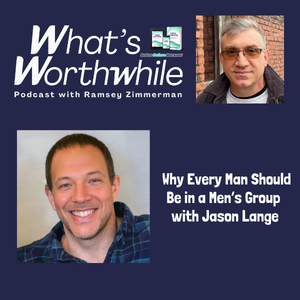
[00:01:29] Speaker A: Hey there. It's Ramsey here. That was Jason Lang. Jason is a men's embodiment coach, group facilitator, certified, no more Mr. Nice Guy Coach. And he's an evolutionary guide.
Jason believes and says that every man should be in a men's group to benefit from the growth and support the men's groups provide.
Jason needed those.
He shared with me that when he
[00:01:54] Speaker C: was a young man, he had no
[00:01:56] Speaker A: idea what to do with himself.
But the mentoring and leadership that he got through his experiences meeting with other men made all the difference.
[00:02:05] Speaker C: We talked about how it is simultaneously
[00:02:07] Speaker A: the worst and best of times for guys struggling to do their best.
On the one hand, we have all kinds of societal, professional and relational pressures and criticisms.
But on the other hand, there are more and more opportunities for guys to find and meet with other guys who are striving to get beyond either the old stereotype of silent strength or the new ones of red pill domination or beta. Nice guy. I think Jason's perspectives and understandings about modern manhood are wise and useful, both for men and for the women who love them.
Let's listen in.
[00:02:46] Speaker C: Hey, Jason, how are you doing today?
[00:02:49] Speaker B: Doing so good. Thanks for having me.
[00:02:51] Speaker C: Yeah, totally. I'm so glad that you're here. You're taking the time to chat.
I've been thinking a lot lately, putting a lot of thought into group work and what that's all about and how to do it well. So I'm really happy that we get a chance to talk because I know that that's also something that is very central and very important to you.
[00:03:17] Speaker A: Why don't we, why don't we start there?
[00:03:19] Speaker C: Like why, why is group work so important to you, specifically men's group? Like what, what happened in your life that sort of gave you that epiphany and that sort of core value around group work?
[00:03:35] Speaker B: Yeah, absolutely.
My experience and why I'm so passionate about it now is really, it's what worked for me.
Right. So starting as a young man in my mid-20s, I got into my first men's group and really I've done a lot of stuff, you know, coaching, therapies, plant medicines and they all have moved the ball for me. But the one that has most consistently changed my life is men's work and men's groups and really doing deep work together, in my case with other men in a group.
And as I just kept doing it for my own well being, frankly, I just wouldn't shut up about it. And people started asking me like, hey, can I come? That sounds awesome. Like I've never done anything like that. Can I come sit in your group? And this was about a, I don't know, nine years ago, almost 10.
I was living in LA at the time and my group just met and one of our members, he was a therapist, we'd met in his office and so it's a pretty teeny room with, we couldn't really fit more than nine guys.
And so guys kept asking me and I just was like, you know what, I'm just going to start hosting, dropping groups on meetup.com out of my living room in central LA. And it was amazing. I just discovered I really loved it. And I discovered men were longing for it, like hungry for a real space to get honest about what was going on inside them.
And it really just kind of unfolded from there. And what I've now seen in addition to my own journey is, you know, I do private work with guys, I do private coaching and sometimes, you know, I love that. But man, I love more than anything else is working with guys in a group just because so much more can happen.
And it, what I've seen is it just accelerates the process of healing so much more quickly for so many men.
[00:05:29] Speaker C: So if you don't mind sharing what were some of the sort of primary issues that you were going through in your life that you know, those other modalities which you Described maybe helped a bit.
But what were the things within you that the group work really made the impact on?
[00:05:53] Speaker B: Yeah, I would say, you know, my first incredibly memorable experience I often share was I had been in, you know, this was probably. I was like, 26, 27 maybe. And I had been in talk therapy for maybe a year or two. And at that point in my life, my biggest pain point was I had never been in a relationship.
I was a late bloomer. I was a virgin.
Since my teenage years, I had wanted to be in a relationship, but my body would get, like, really anxious and tight. I wouldn't know how to connect with women, and I'd get really stuck in my head. And that kicked off, in a lot of ways, a journey of growth for me.
And I had been in talk therapy, and turns out, like a lot of men, I think, pretty strong mental capacity in me. And I kind of figured out, strangely enough, just how to be vulnerable enough with my therapist to feel like we were kind of doing work, but it wasn't really moving the ball for me. And then I got into one of my first deeply facilitated men's groups with an older mentor of mine who's since passed, and he did more of, like, a somatic style of work, but in the group.
And no joke, within 15 minutes of the attention being on me and this process he ran in the group, I was on my back, bawling, crying like I was 2 years old. My arms were in the air, and I was just screaming out, hold me. Hold me. Where are you?
And this deeply neglected infant and little boy, because of the way my family system was, came forward for the first time. And I got in touch with it in a way I had no idea before that there was a part of me that just hadn't really been held or comforted or touched, particularly by my mother. And that had all kinds of downstream impacts.
So bringing that forward, having that experience while being witnessed by other men was so intensely vulnerable for me.
But it completely changed my relationships with those guys and my relationships, frankly, with women moving forward.
And from that point on, they knew something about me that I hadn't been able to discover on my own.
And it was through the kind of group process and then seeing other people go, and then I'm going, it created a space I couldn't get to in any other way at that point in my life.
[00:08:38] Speaker C: Yeah, well. And I think that's. That's relevant, the idea that it's a space that you can't get to otherwise, because, I mean, guys get together you know, we hang out. Maybe we're at, like, a sports bar, watching the game, you know, or maybe it's not even in real life. Maybe we get together online to play video games, you know, go on a quest.
Certainly we get together a lot in, like, a business context, but it would be quite a different description. Or, you know, if you were laying on your back crying during any of those events, that would probably not be considered a success. That would probably be considered a real problem.
So how is it that, you know, these organized men's groups, especially with something like Somatic Therapy, which is, you know, geared specifically to understanding the body and how our emotions and things get expressed or not expressed through our body, how are those fundamentally different from the kinds of everyday accepted, if you will, kinds of experiences that men have with each other?
[00:09:56] Speaker B: Yeah, well, I often talk about the kind of default mode of relating for most men, which comes, you know, there's a little biology. There's a lot of cultural pressure around it. But the default mode most men relate through is what I call triangulation.
Right. So me and you get together, but then we literally have our attention on some third thing. We're watching a sports game, we're doing an activity, we're fixing something.
And so our connection comes through having the shared attention on something else, which is often how a lot of men connect. And I'm not here to, like, knock that. Right. It's super fun to go out and play a sport with someone or do an activity, but what that doesn't do is create connection between us in terms of what's going on inside of us.
So a men's group, in a lot of ways, in this kind of group work, what it's really doing is just turning our attention toward each other.
So the object of our attention is each other and what's happening essentially inside our bodies and, you know, in our lives.
And that structure is just not something a lot of men are familiar with or know how to do because we get so much cultural pressure, right, as men, to be tough, to not share emotions, don't be vulnerable. You can think of all the locker room slang we could throw at a man, you know, if he started expressing something. And one thing, I've literally led thousands of groups at this point, and one thing I often hear from guys is one of the reasons they don't is, well, I don't want to be a burden. I don't want to be a burden to you, Ramsey. I know you got a lot going on in your life. I don't Want to put my grief on you or my fear on you. So I'm just going to hold it inside and we're going to go play around, a golf, whatever, and then we'll get on with the day.
And all these things start to add up where men just hold so much inside by default and oftentimes don't even know what they're feeling inside. Because another, you know, place that men are just often under trained is that kind of bodily, emotional awareness.
And so then we don't really know how to talk about it, so we don't talk about it. And instead what a lot of men will do is just drift. And I'll see this in men's groups. If I don't hold a good structure, men will drift to talking about things, concepts, politics, culture, right? It's just kind of where they go.
And often it's anywhere but right here. What's going on as we're sitting here with each other, what's going on in our lives right now? So a good men's group, what it does is it gives men a space and a structure to really slow them down, get them connected to their bodies, to their emotions and what's really going on in life.
And then we throw in the group component. This is what gets so key, you know, whether it's mirror neurons, just connection itself.
As one man starts to go deep and feel, other men start to resonate off that.
So the part right, I didn't say in that check in about my experience was I was like the fourth man to go.
So I had witnessed other men not necessarily going into that exact same emotional content, but being vulnerable, feeling their bodies, expressing in a way being authentic in a way I had never seen before.
And seeing that started to move something in me like, oh my God, these guys are, they're going for it. I'm going to go for it. Right. I was inspired by them. And that's one of the things I often see in a group that's so fun about the process is as each man steps in, sometimes within an individual evening or sometimes over time, the group starts to get deeper and deeper because when you take a chance and express vulnerably, it often gives me permission to do the same. So it kind of becomes this chain reaction that is so fun to participate in.
[00:14:02] Speaker C: I'm going to push back a bit because maybe it does that or maybe it just feels really risky and terrifying to be in a group setting like that and to maybe have some intention of sharing some things. But, you know, just having inside of you, all of these experiences or, you know, shame or disappointments or things that are, you know, clashing against each other, that you've spent years, you know, trying to hide, trying to forget, trying to feed. And isn't that also an experience that many men feel, especially when sort of trying to do a group for the first time? And how do you deal with that?
[00:14:52] Speaker B: Well, some men are terrified, for sure. They're like, oh, my God. But this is where. And I actually, you know, I've heard this. Like, this isn't me making it up. It's, wow.
I wasn't gonna talk or share about this, but when I witnessed you go through that thing you went through with your dad and bring it forward and express that, that actually inspired me and reminded me, oh, I got that stuff. My own version of that. And now I want to bring it. And I'll often hear that from guys.
It wasn't something I was gonna bring until I saw another man literally lead the way. This is one of the things I love about groups now is it starts to redefine a type of leadership where going first and being vulnerable.
Yes, it has amazing impact on us. Like, we get something out of it, getting to share and express these ways. But the thing that really starts to light up a lot of men is when they realize, wow. And it actually serves the men I'm with because it makes them feel safer to go the same in the way. Sometimes I just witnessed a man, and so it actually becomes this kind of co leadership of the more willing I am to play full out, the more I'm supporting you in doing the same, and I want to support you.
[00:16:15] Speaker C: Right.
[00:16:15] Speaker B: That's like a real thing that comes forward in groups. Like, men love to serve each other in these ways, and it becomes really powerful. And sometimes the, you know, the backlog or the fear, there's just an energetic that helps men kind of break through that. And, you know, the groups I lead at least very, very hold very tight container in that we never force a man to go anywhere he's not ready to go, you know, on herself is one of the biggest commitments I start every group with, because the old, like, you know, the kind of old 60s, 70s, crazy wisdom push people, get them triggered, have them have these big reactions before they're ready. It doesn't work long term, and it actually often ends up hurting guys more. So I really am passionate about creating the space where a man gets to choose how far into his edge he goes, and we celebrate that man, even if his movement is just here. To here, like one tier. For some guys, that's like a lifetime's worth of expression that might look totally different from another guy's, but is just as meaningful for them. And so every man's kind of coming in in a different place and gets to express in a different way. But again, there's this kind of sense, particularly in groups, I lead that meet over time, kind of being in it together.
Right. It's like, oh my God, you're going for it. I'm going for it.
Let's play full out. And it's not so much from a shame place, but like an inspired place.
[00:17:56] Speaker C: Yeah.
[00:17:57] Speaker A: What are.
So what are some of the aspects
[00:18:02] Speaker C: of that container, you use that phrase, that, that container, that space that's created for men to have that experience.
What are some of the aspects of that container that make it effective and make it safe and make it a place where people will actively participate and want to come back and get a lot out of it?
[00:18:29] Speaker B: Yeah, absolutely.
The general term for this I would use is our agreements. What are our agreements? Literally, what are our conscious agreements that we're entering into during this shared space and time with each other? And for drop in groups, you know, I'll literally make everybody affirm those every single time.
For groups who are meeting repeatedly, sometimes we'll introduce it one and then, you know, just do a quick yeah, in each group. But essentially you're right. There are agreements that do two things. They create safety and they facilitate depth.
So not just floating up to the talking about the latest sports game kind of thing, because you can do that anywhere. And time in a group is actually quite precious. Especially when you have, you know, eight to 12 guys, some of whom have families and lives.
It's very precious time to spend in a group, so you want to make the most of it.
So there's tons of different agreements and different programs I have, we'll run different ones. But some of the basics are, like I said, honor self.
You agree in advance that you don't have to do anything that feels out of alignment or out of integrity for you. So in the moment, if something's coming up, someone asks you to participate in some way, and you're like, I don't know, do I want to do this?
You've already agreed. You know what, I'm just going to honor self. I'm not going to participate in this practice or whatever. And it's incredibly important for men to feel that choice.
Honor each other is another simple one of just knowing that group work is group work. And it can be messy and it can be triggering. And you're going to get feedback, you're going to give feedback. And we just want to do our best to remember we're all here to serve each other. Right? We're all here to help each other become the best men we can be. And we want to honor each other in there, in each other's processes as best we can.
And then probably the biggest one for men is confidentiality. It's just knowing whatever comes forward in that circle is not going to leave that circle. Because so many men, particularly if you do more of a local group, oftentimes, you know, you have friends and connections and your spouses might know each other and there's like a lot of overlap and if guys don't feel safe to reveal thinking, I don't know, is he going to go out and tell his wife what I just said, that they're not going to do it. So you have to have a very tight container around. Hey, everything we speak here in this group stays here in this group. Unless you get explicit permission from that man to bring it outside to someone else. And there's, there's, there's more than that for sure, in terms of like body based feedback, staying present in the group, transparency, vulnerability, you know, there's many like that. But again, what they are are agreements that facilitate safety and depth. Meaning we're not here to just relate in the default way.
We want to relate in a different way here to take advantage of this structure and time we have with each other.
[00:21:39] Speaker C: Yeah, we're here to do some real work on ourselves and with each other and to help each other out.
You know, a lot of the, a lot of what I do, what I've been learning about the last couple years, have to do with nutrition and with healthy lifestyles in general, like the foundations of good health, which have a lot to do with habits.
You know, even things as simple as getting to sleep on time and getting the proper rest and getting exercise and you know, eating whole foods. You know, simple basic things like that.
And also just understanding our stress response and how to, how to manage stress properly.
Do you see those kinds of foundational issues coming up in men's groups? And do you think that it, you know, plays a part in those kind of foundational health issues? And if so, like how.
[00:22:53] Speaker B: Yeah, absolutely. This, this I, I call that kind of bucket you just named the unsexy work. It's the stuff that, you know, isn't fun to like hype up on an Instagram reel or Something it's like, yeah, get to bed, drink enough water, eat whole foods. You know, these are like, move your body once a day.
They're not as sexy as like, go off and do the plant medicine or the thing. But they're so foundational to a man's well being. And where a men's group becomes really useful for them is implementing them.
[00:23:25] Speaker C: Yeah.
[00:23:26] Speaker B: One of the great functions of a men's group is accountability. Is here's what I want to do in my life and why.
And as men, by default, we like to think, well, a real man could do it all by himself.
[00:23:40] Speaker C: Right.
[00:23:40] Speaker B: He's just going to do it with willpower.
That almost never works long term. Willpower is this incredibly finite resource, you know, all the research shows. And instead what works is structure and accountability.
And so in many men's groups, I can't tell you, like to totally out myself here. There have been many times there's been something, whether it's foundational to my health or like, oh, I got to send this uncomfortable email to someone or whatever that I bring forward in my group and say, this is the thing I want to work on before I come back here next week. And the only reason I end up getting it done maybe two hours before the next group, two weeks from now is knowing I'm going to have to walk in that room and report.
And that might sound like, oh my God, that's not very strong or lazy, but it works. It's effective is what matters to me. And then the other thing, I've seen like a number of my men's groups, I'm in one where a lot of guys had shared health goals. Right. Literally all we did was start a chat that's for workouts. So anytime someone goes and works out, they're just say, hey, I just had a kick ass workout. I did this. And like, there's not much else in the chat other than that. Maybe sometimes posting some PRs or a good day or a gym shot or something.
But what makes that so effective is it's actually quite inspiring. And there's like a momentum to seeing all your buddies take care of themselves. That actually makes it a little more fun to go take care of myself too.
So I see these things frequently come up.
[00:25:18] Speaker C: You get some high fives on the group chat, some attaboys, a little bit of challenge, like, well, I'm gonna do
[00:25:26] Speaker A: more push ups than that.
[00:25:28] Speaker B: Yeah, totally.
[00:25:29] Speaker C: Guys are all about it.
[00:25:34] Speaker A: Look, we all deal with stress. Stress is not the problem. The problem is that our body's Innate stress response is built for physical challenges instead of the mostly mental, emotional and virtual stresses that we face today. In my book, Stress Response, you'll learn to manage your response to stress in order to reduce anxiety, avoid burnout, and find calm and steady focus. The ebook is available on Amazon and only 99 cents for a limited time. After you download, please don't forget to leave an honest review and rating so that others will find it too.
[00:26:13] Speaker C: You know, guys are not all the same, right? You know, there's different, everybody's different.
But I think there are some really sort of familiar stereotypes or archetypes of men.
And there have been different ones. You know, some of them are tied to generations or age, or they're tied to sort of place in life. But, you know, to what extent do you see those? Do you name those? Do you. Is it helpful to define archetypes like that and for people to sort of see themselves in them or to see the guys around them in them to help people understand themselves and understand others? And how much of that is just bs, like, you know, like how much of that has just been assigned to us, you know, inappropriately? Like, what do you think about archetypes and stereotypes?
[00:27:13] Speaker B: Yeah, I think archetypes, stereotypes, personality types, they're useful lenses, but they're not the whole reality, right? But they're often a way to get a quick sense of something.
And there often are just similar patterns, right, that play out in some big ways in terms of how men show up and how they process life and deal with things that are then useful of like, oh yeah, this is why it's useful to see the pattern is, well, then we can look at all the other men who have had that pattern and what moved the ball for them, right? And then you start to collaborate on, oh, hey, here's what worked for me. And there are many. I work with guys on kind of some at a more specific level, some at more of a cultural level. You know, the most basic ones are what I often kind of named the. The. The three models for masculinity. Most guys have kind of intuited that none of which are quite effective or life affirming at this point. And the first one's just kind of the old school. You know, we just call it literally the macho jerk, the kind of my way or the highway guy. He's actually, in a lot of ways, he's in touch with his power and his desires and just goes for what he wants, takes what he wants sometimes. And at the extreme version, as you know, we have unlimited examples of in our culture. And it was kind of that old patriarchal, the man says, this is what happens style.
And those men still exist. And there's certainly a red pill culture right now that's wanting to try to rewind the clock to that. Like it was some magic thing when.
No, not really.
And then as a response to that, there's kind of been the emergence this guy, author, Dr. Robert Glover, who wrote no More Mr. Nice Guys, one of my mentors and in a group with me, and he wrote one of the best selling men's health books of the last 20 years. And every year it sells more copies than the last because more and more men are falling into this archetype, which is.
I either a experienced firsthand the negative consequences of being around a man who's kind of that domineering my way or the highway, unemotional self that could be a father, an uncle, teacher, you know, anyway, or they've just absorbed it through cultural osmosis.
[00:29:50] Speaker C: Right?
[00:29:51] Speaker B: We're now almost a decade into MeToo and I mean, we still, every week, right? We just had the big Atlantic or Time article the other, the other week about what men can do when they're dissociated from their hearts. So those guys swing the pendulum totally the other way to the nice guy, which is, I do not want to be that guy. I do not want to be a jerk. I do not want to be abusive. I do not want to objectify women. I. I don't want to make anyone uncomfortable. So what I want to do is always make sure you're okay and safe and never put my needs upon you. And there's a noble intent there. And those men tend to be deeply emotional, attuned, very sensitive, but they lose touch with their power, their desires, their ability to just set healthy boundaries and sometimes say, no, that's not okay, what's happening right now.
It's a form of codependency.
And more and more, I work with a lot of guys like that. And then there's you, kind of named. I would say it's a slightly more generational one, but it's still there in the culture because I still get men coming to me, which I would kind of call the more old school, grandfatherly, stoic the guy, you know, you know, maybe served in the war, but has never talked about it once, just has his entire inner experience on lockdown, shows up, does his job, serves his family. But in terms of anything going on inside, no idea. Right? He's just there in all three of those fail men in different ways and cause different kinds of pains and emotional health problems and physical health problems. So I often see those.
There's also, you know, maybe a newer generation, not. Not quite on generational lines, but the guys who just really have a hard time with structure.
Right. Was setting a goal, staying on top of it, taking care of their basic self, and are instead just kind of drifting through life, falling from one situation to the next, and have a hard time kind of getting rooted in themselves and taking intentional action, moving forward.
And, you know, there's certainly more than that. And again, these are kind of generalizations that each individual sometimes expresses in a different way. But the real patterns I do see in pain points that men come in having experienced or being subject to.
[00:32:22] Speaker C: And those all sounded like they had significant limitations. Like what. What would be the ideal. Is the ideal kind of a balance of some of those. You know, is there sort of model. Is there a. Yeah. An effective modern masculine model that you sort of recommend that we should espouse to?
[00:32:46] Speaker B: Yeah, I mean, this is kind of the great work of men's work these days. Is part of what's happened is culture has changed a lot. Roles for men have changed a lot. And so a lot of guys are in pain because they don't know what. What am I supposed to be? What is the healthy version? Our culture spends a lot of time right now pointing out the many unhealthy versions of men and masculinity, but doesn't really show many examples of, hey, this way, come this way, this is what we want. And in that vacuum is where a lot of this kind of red pill culture, I think, has emerged. But in the work I do, it's really about integration. Right. It's about kind of taking the gifts of all those things. And I just summarize it as kind of three qualities or attributes.
And one is just the first part is the simple capacity. Sounds simple, but it takes work to just be grounded and relaxed and connected in your body, in the moment.
[00:33:44] Speaker A: That's it.
[00:33:45] Speaker B: Just grounded. Here I am, I'm feeling my body, and I'm relaxed, not holding a bunch of physical tension in my body like so many men do.
And as that foundation anchors that this kind of grounded, relaxed nervous system and presence, then we move up to the heart, and it's the capacity to actually open our heart and be sensitive, to feel not only ourselves, but the people around us. So the skill of attunement really comes from there.
So, yeah, I can still step into my power, my desire, my Leadership, but it's attuned to you.
It's seeing the impact it's having on you and also curious about what you want. Right. So it's not that old domineering style.
And then the third one, which I think is actually increasingly becoming important too, because of just technology in particular, is what I call just focused awareness.
It's the capacity to decide where you're putting your attention in any given moment on purpose.
And there's actually a lot of money to be made now in social media and all kinds of things for distracting men and pulling their attention. But that simple capacity to.
I want to drop in with you right now and be focused on you and stay with you and not drift up into my ruminating mind or into what I should say or anything like that. That's a real skill set for men that then deepens as well into what I call context awareness. Just. Yeah. What is going on in this moment that I need to be aware of and what's most important for me to focus on in this moment. And when men have all three of those, it's actually super powerful and it's really nice to be around is the thing a lot of men start to experience as they get into men's groups when they feel mental holding those three. It's actually like, wow, I want to be around that person. That's one of the signals I first felt when I got into men's work and I met older men who were deeper in their journey than me.
I remember that guy actually, who led me through that process. It was so funny. I was 26 at the time. Right. I remember doing this work with him and kind of watching him work the group. And I had this deep body sensation of, oh, my God, that's what I want to be when I grow up. And. And it wasn't what he was doing, it was how he was being like. He was very directive, calm, felt safe, was not dissociated. Like, it was so amazing to witness. I was like, that's what I want to feel like when I get old. I want to have that kind of nervous system.
And as I've kind of dissected that, those three attributes are kind of what I've come up with. So, you know, the more crass way to put it, too. I'll just say that we often talk about in this.
A lot of guys fall for the binary of either or. You've either got balls or you've got heart and you're powerful or you're sensitive. And the new work is really bringing those two together. Like I said, that we can be in touch with our power and desires, but as long as we're deeply attuned to our environment, in our relationships and even ourselves, so many guys dissociate from ourselves. I'm going to go push, I'm going to work, work out and injure ourselves, work too hard, because we're not actually paying attention to what our body needs.
[00:37:15] Speaker C: Well, it's so interesting because what you described as an ideal, you know, set of attributes for a guy had absolutely nothing to do with their prowess or their achievements or, you know, actions that they're taking. What you described is someone who is grounded and attuned to other people and is focused on sort of what's going on around him.
And, you know, I think in popular culture, it's even hard to say popular culture anymore because there's probably so many different variations of popular culture.
But I'm just not, you know, you don't see that set of ideals very often put out there.
I'm wondering if you think that is it.
What's it like for guys now versus before? You know, is it better or worse now than it was five years ago, 10 years ago, 20 years ago, you know, whatever. Like, what do you. When you look at kind of this moment that we're in, what do you see in terms of, you know, the good, bad or indifferent that it's doing to men these days?
[00:38:38] Speaker B: Yeah, I would say it's a bit of a contradiction here, but in some sense it's harder for men in that a lot of the roles men ascribe to and were prescribed to, of what it means to be a provider and a real man and all this kind of stuff, it's dissolving in real time and it's no longer sufficient. Right.
One of the most common, painful things I work with a lot of men on middle aged, they got on the escalator when they were young, right? I'm supposed to get a great job, get married, have kids, and as long as I provide for them financially, I'm a good man, I'm a good husband, I'm a good father.
And then they get to, you know, 45, 50 years old, kids are maybe getting to empty nest age, and their wife comes to them and is like, I'm out, I'm done. I don't love you anymore. We haven't had a relationship in 15 years.
All we've been doing is managing kids and you've been working and like, I'm not in anymore. And they often Come like, oh my God, what do I do? Like, I'm in so much pain. I can't believe this is happening. I thought I was doing what I was supposed to do.
It's not sufficient anymore, right? We're being asked to bring more as men to, yes, sometimes provide financially, but also provide our presence, our emotional attunement, our involvement in our kids lives, our capacity to lead our relationship relationally and emotionally. And so a lot of men are being confronted by that. And then simultaneously, you know, the job market is changing so fast, the educational system is changing so fast, women are getting higher degrees faster than men. A lot of the kind of safe jobs for men are starting to disappear. I'm even starting to see it with my generation.
We were basically promised if you get a degree in computer science, you're going to be good to go for life. You can have any job you want, you're going to be financially secure. I'm working with a lot of those guys now who are like, I've applied to a thousand jobs in the last year and it's all going away, you know, AI, it's just changing very fast. And what that confronts men with in all kinds of ways is questions of identity. If my identity has been solely revolving around my capacity to provide, when that goes away, it's a massive disrupt and crisis for a lot of men. So a lot of guys are stepping into that or they're out there trying to date or have a relationship. Their partner makes more money than them, is more organized than them. Like these things are real these days. So a lot of men are like very confused as to what to be. So that's kind of some of the challenges, I would say. But the positive is stuff like this. There has never been a better time for men who want to take responsibility for their pain and where they're stuck in life to get the kind of help to discover something new. You know, when I got into my first men's group in 2006, if you talked about men's groups, most people would only relate it to aa, so some kind of recovery work or like a church Bible group. And both of those are great. But it's very different from what's starting to emerge now, which more and more men are having access to, if for no other reason than technology itself is also playing a big part. Where back in the day, you know, I was in a men's group because I was living in Boulder, Colorado, which is this like little hippie, transformational, you know, kind of leading edge place.
I still Work with a lot of guys who live out in more rural areas or different parts of the country. And they're like, what are you talking about?
This work doesn't happen here. Right. Like, it's just not. There's maybe a yoga studio. That's it.
But now, because online, they can start to access the culture and start to meet men who are relating and working in a different way.
So the challenges are huge. But this is the thing for men who want to take responsibility and say, I want to live differently. There's never been an easier time to access the different teachings, work, even community, than before.
So it's been a tidal wave, even, honestly, in the last five to six years. It's pretty rare now. A week or a month doesn't go by where someone doesn't send me an article about the male crisis, the boy crisis, the loneliness crisis. It's starting to get attention, and people are starting to adjust.
[00:43:07] Speaker C: Yeah.
So how do you professionally work with and help men, either to get them into men's groups or to help them start men's groups or to you know, make their men's groups effective? Like, what do you offer? How do you help?
[00:43:30] Speaker B: Yeah, I work the whole gamut. So a lot of my programs are actually just different versions of men's groups. So one of my most popular ones is a men's group for guys that want to get better at intimacy, so whether they're dating or in a marriage, but want to actually be able to create more of the type of connection they want.
And so guys come into that, and they come in thinking, I just want to have more sex with my wife or have more relationships, and then it turns out to be deep inner work. It's just the kind of the sucker punch I always get them with where it's like, nope, here's what you actually need to do. And they're like, oh, my God, you're right. And then they do the deep inner work, and all that stuff improves. But it's in the context of a men's group. Right. So they're getting to see other men in their journey and their challenges and their discoveries, which accelerates the learning quite quickly.
Then I help men start groups. One way is I do an experiential one called the Heart of Shadow, which is where we actually take men through a shadow work men's group, which is a very specific type of men's group to do the kind of more deep, cathartic, emotional work, like I experienced in my first group of, like, really getting into our bodies and Discovering what are the habits and protective mechanisms and traumas that are really guiding our life that we sometimes don't even realize.
And the way we do that group is my co facilitator and I.
Because it's super edgy for a lot of men, we start virtual. So we meet for six weeks just over zoom. So guys, they just start to feel a little comfortable with each other. They see each other, do a little bit of vulnerability work, but then we go on retreat with each other for four days and we go very deep. And because we've already built a lot of trust, it's like an accelerator in a really incredible way. And then we teach the mental how to keep meeting after that. So we've. We're about to launch our eighth group, and every group just keeps moving forward. Now it's like, oh, this is a virtual men's group. I take with me after the program ends. And then I have more explicit trainings of just like, yeah, you want to start a men's group? Here's a structure, here's how I teach it.
That I have called Men's Group Mastery. And then I have just a light one called Men's Group Experience, which is like, okay, I hear you talking about it. What does it look like?
And it's just a virtual 12 week program where guys get to go through a group together.
And then I just podcast kind of nonstop about men's groups and why you should be in one and how to create them effectively and whatnot. And you know, I will say, for some guys, the trajectory they come in on with me is they do start with private work. Because one thing that's probably not talked about quite enough in the men's work world is sometimes some men's deepest wounding and pain actually has come from other men, whether in peer groups or fathers or brothers.
So just being in a space with eight other guys can be really activating for their nervous systems. So sometimes I'll have guys come in and work with me privately for a while.
Just start to rewire that, okay, I can feel safe with this guy. And. And then they're like, well, I trust you, so I'll trust you to take me in with this group of men. And then it starts to kind of reformat their nervous systems and realize, okay, not all men are like that.
The guys who damaged me.
And it can be profoundly healing.
[00:46:52] Speaker C: Yeah, well, that's great. How do people find you online? Where do they go to learn more?
What's the. Where do you send folks?
[00:47:05] Speaker B: Yeah, absolutely. Easiest way to keep up with me and all my programs and me talking about men's groups nonstop is at Evolutionary Men. So it's not dot com, but dot men. And on there, yeah, you'll find all the programs. I run retreats I run writings I've done. And, you know, the mission. My mission, in a lot of ways is very simple. It's every man should be in a men's group.
And so even if you don't want to work with me and you're like, I live in so and so, I don't know where to start, just shoot me a line over contact. I'm so well networked in the space now, I can usually refer and help you find stuff in your area. It doesn't have to be with me. Like, guys, get into groups as fast as you can. I think our culture really needs it right now.
[00:47:53] Speaker C: Well, that's great, Jason. Thank you so much.
I agree so much that we need it.
You know, there's not.
It's not as obvious for guys how to relate well with one another.
We're often not in touch with our own selves, with our own bodies, and just, you know, the. The work that's going on in the men's group space I think is just really important. I'm learning more and more about it, and I just so appreciate you coming on and, you know, talking to us about this today.
[00:48:37] Speaker B: Yeah, thanks so much for having me and helping get the word out.
[00:48:42] Speaker A: Ready for more? Visit whatsworthwhile.net to listen to podcast episodes. Master your response to stress by reading my book, Stress Response, available through Amazon, or to get better before burnout sets in by requesting the free guide. Regardless of where you are in your
[00:48:58] Speaker C: journey, I'd love to hear from you
[00:49:00] Speaker A: and talk about how we might move forward together.
Please contact me, Ramsey Zimmerman, through the website or on social media like Instagram, Facebook, LinkedIn or X. Thanks,
[00:49:19] Speaker B: Ra.