[00:00:11] Speaker A: What's worthwhile considering what we consume, believe, say and do towards peace of mind, vitality of body, and joy of spirit? I'm Ramsey Zimmerman. Here's some more healthy living, motivation and discussion.
[00:00:31] Speaker B: Being able to have a partner with you in whatever capacity that is financial.
Can I. Can I talk to you and even share my spiritual beliefs and morals and values with you?
Can I share my emotional needs with you? Or do I have to be, you know, personally perfect and, you know, completely, like, have this mask and this image that everything is good all the time?
That's not safety. The safety comes with being who you are, living life and there being no judgment, no dismissal, no minimization, not having it used against you later.
You have access to that person. They have access to you. You have access to their emotions, their finances, the.
You know, what's going on with them. You're letting each other into your world and without reservation.
[00:01:34] Speaker A: Hey there. It's Ramsey here.
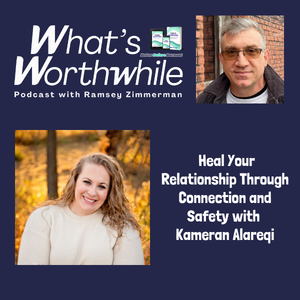
That was Cameron Alarici. Cam is a Gottman certified marriage coach, the host of the Married and Connected podcast, and the founder of the Recognizing Potential coaching program.
She's not shy about talking about her lived experience with marriage, divorce, and reconciliation.
Cam and I talked about attachment, the different types of people, and how crucial it is to be honest with our partners.
I'm no expert on relationships, which is why I appreciated so much the education that I got from Cameron during this conversation.
I hope you get a lot out of it as well. Let's jump in.
Hey, Cam, how you doing today?
[00:02:20] Speaker B: I'm great. How are you?
[00:02:22] Speaker A: I am doing really well. You know, I'm excited to talk to you today because, you know, usually on the podcast, I talk to people a lot about holistic health in terms of, like, mind, body and spirit, but I haven't had very many people on who are experts on relationships, and I've been sort of more focused on the importance of relationships and how that relates to health and that sort of thing.
So happy to have you here.
You are a marriage coach. You're trained and certified, but you're also qualified based on your own personal experiences with positive and negative experiences with marriage.
So let's. Let's maybe start there. What have marriages and divorces and marriage and reconciliation.
What's that been like for you over the years and how did it inform what you do today?
[00:03:26] Speaker B: Yeah, yeah, great question.
This is what kind of makes me one of one out of, you know, all of the marriage coaches, Most marriage coaches that you find, they've been married to the same person, and maybe they've had hardships in their marriage, as one does, but they've never actually been divorced and then gotten remarried or they've never been divorced and reconciled. I only know of a couple that have. Have gotten divorced and then reconciled with the same partner.
What I will say, what it's taught me is that your childhood is going to basically map out everything that you're going to go through in your marriage if you have not worked through that.
Nobody is technically qualified to be in a marriage until they've learned to be in a marriage.
And yeah, like, there's so many different misconceptions that we take into marriage based on either Disney, what we grew up watching as kids, or our parents, what we saw growing up and what they did. And we just, you know, gather that it's quote unquote normal. And it's actually, it. It is. What's normal is common, but it's not normal. Right. Like, it.
I don't know that there is a normal, but what's common is not a lot of times healthy. And I, I know that you, you know, experience that in all aspects in terms of what we eat and how we.
The thoughts that we think and everything. It's no different in relationships. So I've. I have learned a great deal in terms of why I got married the first time, why that marriage ended in divorce, why I got married the second time, and why that marriage has worked so well with reconciling and.
[00:05:24] Speaker A: Well, that sounds like we have a lot to talk about.
So why don't we start with, you know, being married and being a married person and being in that kind of relationship. I don't think that's something that is formally taught to us oftentimes.
I think that's such an interesting vision that we sort of learn from Disney or from stories what it should be. And then we're simultaneously experiencing maybe the marriage that our parents have. You know, how is it that, you know, our experiences and the things that we see and perceive as young kids, you know, early in life, how does that really set us on a path for what our own marriages are going to be like later in life?
[00:06:27] Speaker B: It's everything.
So from birth to three is when our attachment styles are created. And so you will either have a secure attachment style because you know that your parents are always going to be there, always going to meet, and this is the key. They're always going to meet your emotional needs. I meet with clients all the time that will say, I had a great childhood. I don't know what you're talking about, like, my childhood was amazing. And then when I say, okay, tell me about your emotional needs, were they met now? It's like during the headlights of, like, wait, no, actually, like, I was sent to my room and told to come out when I was quote, unquote, good. Or, you know, sometimes they met them, sometimes they didn't. And now I'm, you know, super anxious in a relationship. So that's what's created there. But birth to seven is when our subconscious is actually being created. So we're kind of in that theta state from birth to seven. We're like a spirit sponge, like, clean. Just, like, soaking up every little thing. And more is caught than taught. So it's not like our parents sat us down and said, okay, this is what a healthy relationship looked like. Because maybe they didn't have a healthy relationship. Most parents didn't.
So what's happening is they're just repeating generational patterns, and we're picking that up. So what, we're gathering as little girls, Rather, we are. We are looking at our dads and saying, okay, this is the type of man that I need to marry, and he treats my mom this way, and she thinks that this is acceptable. So this is how I need to be as a wife. This is how I need to be as a woman. This is how I need to be as a mother, and this is what I need to accept for my husband.
And then we will choose that because that's what we think is strong and right. And all the things. As a boy, we're looking at our parents and saying, okay, so as a man, this is how I need to be. This is how I handle leadership, stress, finances, all the things. This is also how I treat women.
Then they're looking at their moms saying, okay, this is the type of woman that I need to marry. And this is, you know, if I treat her this way, this is how she's supposed to react.
So we're looking at that, and those are the. Those are basically the formulations that we're creating from birth to seven years old.
[00:08:39] Speaker A: So whether or not the.
What we're seeing is positive or negative. Right? So it's not like we have the wherewithal to, at that age, be thinking, yeah, I want something completely different.
[00:08:58] Speaker B: Yeah, yeah, we don't. We don't have that. That wherewithal. And even so, statistically, children of abuse will even say, growing up, I man, I hate this feeling. I don't ever want to be this person. I don't ever want to hit my My kids or whatever. And then they get married and they have kids or that, or they just have kids and they become the abuser and they hate it. There's so much shame that is invoked in that, but it's still like they don't know another way. They don't know how to regulate their emotions so that they don't become that person.
So that's, and that's where the work starts, is looking at those patterns and saying, who do I want to be and why do I want to be different than what I had growing up? And then how can I learn how to do that? It's not enough to know that you want something different. You have to, you have to get help learning how to do it differently.
Do
[00:09:58] Speaker A: well. So there are lots of different dynamics within different marriages and through different childhoods and parenting. Do people tend to gravitate towards other people who have had similar experiences that they did growing up or are there, you know, do people end up very surprised because would they get married, but then they have radically different ideas about what marriage is because they grew up in different situations?
[00:10:33] Speaker B: Not necessarily. So what actually attracts us is like what, what do you hear? The first thing you know when you first meet somebody, you always hear people say, oh, but we have so much chemistry. Well, that chemistry comes from your insecure attachment. And so your insecure attachment is actually gravitating towards their secure attachment because, because only about 25% of the world is actually secure.
So when you're secure, you're, you're gravitated towards somebody else. And it's like your, your biggest common phrase there is. We'll see, we'll see if it works. You're not like, like sucked to each other like magnets where you would be in an insecure attachment. In an insecure attachment, like you have anxious and avoidant that are gravitationally pulled because there's a polarity there.
And so that chemistry that you're feeling is just your insecure attachment being attracted to the opposite of what theirs is. And this is actually what causes a lot of conflict in relationships because we don't understand each other. We don't understand like an anxious is going to need something different. They're going to have a different core wound, a different core need than what, what a dismissive avoidant would be. Fearful avoidance are really interesting because they can run the gamut of both anxious and dismissive avoidant in like a 10 minute time span. But their core needs and core wounds are even different than the others as well. And so it Takes a lot of understanding and a lot of knowledge and a lot of working through that as individuals to become secure, to then decide, okay, is this actually attractive to me? And this, is this what I want for my relationship? And, and people just don't have that knowledge. It's just not taught.
[00:12:18] Speaker A: So before we get too far, can you give us kind of a working definition of attachment? And what's the difference between secure and insecure attachment?
[00:12:27] Speaker B: Yeah, so your secure attachment is basically how you were parented and the attachment that you had to your parental figures or your caregivers as, as from birth to three. Okay.
Insecure.
So if a dismissive avoidant. If you're a dismissive avoidant, what's going to happen is you're going to look back on your childhood and realize that your parents weren't really there for you emotionally. If you had big emotions, if you had a, an emotional breakdown because you were told no or what have you, you, you couldn't have that toy. Whatever. You were either you were punished in some way for having emotions. You were sent to your room. You had to learn how to regulate on your own.
Well, a child from birth till about almost 10 does not under. They don't have that capacity. Their brains, their prefrontal cortex, where they actually have logic and things, they're not operating on a prefrontal cortex neurologically. They're, they're operating from their amygdala, which is all emotional brain. Okay. So they're actually using their parents to know how to regulate.
So for instance, I have a five year old son, so whenever he gets upset, his dad and I will put up, we'll say, do you need a hug right now? And he at this point can say, not right now, I'm not ready. Okay, cool.
And so we'll just sit there, we'll sit with him. But a lot of times our parents just left, they walked out of the room, whatever. We were just there on our own to figure it out.
And so now, so with a, with an anxious, you either had one of two circumstances, either you had parents that were maybe one parent that was really volatile emotionally speaking, or like they had really big emotions, couldn't regulate themselves.
Or you had one parent who may have been really emotionally in tune with you and one parent that wasn't emotionally attuned at all. So it was almost like this constant like push, pull of okay, I don't really know what to expect. So you just become really hyper aware of all of the dynamics and the, the body language and tone and all of that in your household as a child.
So you, you're literally constantly on. In fight or flight mode. So you're constantly anxious, okay? You take that into a relationship at the core center of it, everyone is basically afraid of being abandoned, but with a dismissive avoidant, they're afraid of being engulfed. So like, so I have a cup here, right? So you take this cup. If you're looking at a dismissive avoidant, their capacity is only going to be about a quarter of this cup, right? But an anxious is going to be like three quarters of this cup. So what happens when an anxious pours into a dismissive avoidant? That they're completely overflowing with love and attention and all the things and it's, they're drowning. And so it's like, I'm suffocating. Get me out of this relationship, get me out of here. Right? And that's why they pull away and run away. But then what happens when a dismissive avoidant pours into an anxious? Their cup is only about 3/4 of the way full. And so like now we've got this dynamic that is like, well, you don't love me enough.
And the other one's like, well, I feel like I'm in a prison because I can't, like I don't have any autonomy. You want to be a fifth stage clinger with me all the time.
And so like this is where the conflict starts. Do you see what I'm saying? And then fearful avoidant. A lot of times fearful avoidant will have a lot of trauma as a kid. And that's the other insecure attachment that we've got. So that trauma is going to then invoke a lot of like fear of, of abandonment. They're going. Fear of betrayal, being betrayed is a really big thing for, for a fearful avoidant. So anytime, even like if you use the wrong tone with them, a lot of times it's like, wow, that's a huge betrayal to me. And so they feel their feelings a lot bigger and a lot more. But again, they might run the gamut of being a dismissive avoidant or an anxious in a 10 minute time Spanish.
[00:16:47] Speaker A: We all feel it, the pressure to perform, keep up, move faster, all while staying present and connecting with our loved ones. It's a lot. I know. So join me live weekly on Zoom Tuesdays at noon Pacific time for sessions of better before burnout. Waking, eating, moving and sleeping to beat stress and bring vitality. These sessions are interactive and customized. Each time I go through the foundations of establishing vitality that carry you through your days and calm your sleep through your nights. I also focus in on particular practical strategies. Learn more and register online by visiting whatsworthwhile.net better. Don't forget to use coupon code blastoff for one free session.
It occurs to me that with those different types of attachment in terms of how people relate to each other, you really need in a relationship, you need to be able to identify two things.
One, what is it? What, how are we ourselves?
And then also what is my partner and what is my partner like?
[00:18:05] Speaker B: Yeah.
[00:18:05] Speaker A: And so, you know, how can people begin to understand those two things, begin to understand their own selves and begin to understand their partners?
[00:18:18] Speaker B: Yeah, so this is really important. So actually it starts when you're dating and before you even start dating, you have to have self awareness and who you are and what you want and out of life and who you truly want to be.
Because a lot of times what happens when we're dating is we start setting these expectations of like, okay, this is how much time and energy and effort that I can put into you. A dismissive avoidant is phenomenal at pouring into somebody for about four to six months and being extremely emotionally attuned, like the perfect person.
And then after that four to six months is up, the mask falls off and it's like, I can't do this anymore. This is not sustainable for me. And then it's almost like they shapeshift into somebody completely different.
And then that triggers the anxious. Right. So the thing is, is we've got to, we've got to become qualified to be in relationships to begin with. And that starts with working on your attachment style, going through all those traumas, going through those self beliefs and changing the negative self beliefs that you have, working on all of your bodily chemistry so you're not actually attracting somebody opposite. But also when you get into a relationship, to actually be your true self and to be authentic. Not just because one, one thing that a, that an anxious is really good at is, oh, you like hamburgers. Okay, you might be a vegetarian, but you're going to say you like hamburgers because God forbid the other person, they like hamburgers. Like if, if I don't say I like hamburgers, they're not going to like me anymore.
See what I'm saying? And so then for them it's about four to six months and it's like, actually this isn't sustainable. So I'm going to tell you I'm a vegetarian.
What?
Like that's, that's a huge eye opener of the like, okay, I never would have dated you, I never would have spent this much time with you if I would have known that we had such completely different morals or values or likes or dislikes or what have you. And so, yeah, it starts with being real with ourselves first.
[00:20:25] Speaker A: And I've heard recently, some folks tell me that if you want to connect with someone else, you very much first need to be able to connect with yourself.
Does that ring true for you? What do you think about that?
[00:20:40] Speaker B: Absolutely.
We.
What we don't understand about connection is that we're looking for connection from birth. I mean, studies have shown that, like, if you put a baby in.
In an incubator right after they're born, if they're touched, then they will grow and they will. They will heal faster to where they're ready to go home. If they're not, they'll die.
So we're constantly looking for that connection.
The problem is we're so disconnected with ourselves that we don't know again, what we want, who we want to be, what we enjoy, what we don't. We're not choosing our lives.
We're either going with the flow and going with what society says we have to do, or we're. We are repeating generational patterns that we maybe never even thought of.
So the way that you eat, the way that you move your body, the. The religion that you have, the way that you drive, the type of car that you drive, like, all of these different things, how many of those actually came from your parents, and you've never actually looked at yourself to say, is this what I believe? Or is this just what they believed? And I went with it.
[00:21:59] Speaker A: Yeah, we receive those things by default, and we just sort of hang on to them if we haven't really thought it through.
You know, a lot of my work has to do with stress management and with leading into really solid, foundational, healthy practices in order to, you know, bring ourselves back, you know, from the edge of burnout before we get into that horrible place.
And I'm just wondering how much and to what extent and in what ways you see that connecting to, you know, how we have relationships.
Because I can think of lots of ways, but I'm wondering if that is something that you see and think about.
[00:22:54] Speaker B: I see it all the time.
The.
And it goes back to kind of what we were just talking about with the Autopilot. We live 95% of our life on autopilot. We don't ever think about, okay, why. Why am I choosing Netflix over talking with my partner for 20 minutes.
Why am I, you know, choosing a over, you know, being with my family or connecting with them or what have you. And then we get upset because we feel disconnected. That's actually where conflict comes from. I don't know if your listeners are aware of that. A lot of times we think that the conflict is what causes the disconnection and it's actually the opposite. It's the disconnection that causes the conflict. The more, the more connected you are, the less there is to fight about. Life is easier, life is more fun. Life is, you know, but, but that requires a lot of intention and just like stress management, you know, it would be easy for you to stay up past 10 o' clock and only get six hours of sleep. And then, oh, we wake up the next morning and it's, well, I'll just drink two cups of coffee today instead of one. Well, now, chemistry, like, chemically, we're in this induced anxiety state that we basically chose but didn't realize that we chose that relationships are no different. You have to make sure that you're spending time together every day that you're going through treating your, your marriage like a business once a week and having those conversations about what do you got going on? What do I got going on? You know, kid number one has a dentist appointment. Kid number two has their school sports physical. Which one are you taking? Which one am I taking? You know, these are the bills that are due. How are we, what are we doing here?
Those are all intentional things that we have to do.
And if they're not done, that's when the overwhelm comes in. That's when it feels like our life is running us instead of us running our life and we're all doing it together. And then eventually the relationship ends up looking like a passing ship. And we don't, we don't have that connection. And we wonder why.
[00:25:11] Speaker A: And there's a tension around the, you know, the feelings of feeling burned out that we have and the connections and relationships and like, you know, the better that we feel individually, the better the relationship is going to go. But it's not a simple thing.
It's because I think I, I think in a lot of ways it's because it has to do with capacity.
You know, if you are stuck in a stress response and you're getting burned out and you haven't been taking great care of yourself, you know, ironically, lots of times that's because you're trying to take care of everyone else and you're trying to take care of business. And you're trying to meet all of the demands of your life.
But we often don't have the capacity to maintain, you know, the things that, even the things that we really care about.
You know, I. One of the signs of burnout or one of the results of burnout is, you know, erosion of empathy.
Even even though we want to connect with people that we care about, we just many times don't have the capacity to do that. And that's really tragic. And, you know, it just makes us feel worse because after we've avoided or gotten out of or dodged whatever conversation or responsibility, we feel bad about having just done that.
And then also having those connections, being in a good relationship, have the ability to make us feel better, to, you know, decrease the, the stressed out, burned out state that we're in. So in some ways, the good news is that we can increase our capacity by taking good care of ourselves and we can help our and our partners state of mind and, you know, help them to get out of stress responses through that connection.
So it can either be sort of a vicious cycle and a downward spiral, or it can be a virtuous circle and an upward spiral. You know, there's. I think it's. We can take some hope and some optimism and we can be encouraged by knowing that we can work on either or both of those and they have positive influences on each other.
[00:27:51] Speaker B: Yeah, I agree.
I would also add that I've heard lately, I heard this somewhere, I can't remember where it was, but it was so good. And it talked about the fact that burnout is because of a misalignment somewhere.
And I. A lot of times that misalignment is in our coping strategies that we are coming home and we're utilizing drugs, alcohol, TV shows, scrolling on our phone for hours a day and checking out, but calling it coping or calling it recharging or what have you, when the real recharge is getting more sleep, it's connecting with our family and it's eating a healthier meal and not filling your, your body with things that it can't process or wasn't supposed to process in the, in the first place, like fast food or sugar or caffeine or alcohol like things like that. So we are truly recharging. We are creating a systems. The systems in our life, if those are misaligned, absolutely gonna lead to burnout. So if you're coming home and just sitting on the couch for the rest of the night and you're neglecting the laundry and the dishes and the, you Know, whatever. Mine is always mopping floors. That's the first thing that goes when life gets hard.
[00:29:27] Speaker A: Like, it's like you mop your floors. That's crazy.
[00:29:29] Speaker B: I know, right? Weird. Not as often as I should, but it does happen occasionally. But, yeah, like, it's a misalignment of systems. So if that system. If those systems are misaligned in anywhere in our life, then, yeah, there's things are gonna start falling through the cracks and then just makes it worse.
[00:29:51] Speaker A: No, I think that's a great. That's a great point because we, you know, we think that, you know, oh, it's been such a rough day. I deserve this me time. Right. But it's really not doing the things that would actually help. It's really just you looking for quick hits of dopamine or whatever, like, in the wrong ways.
And it's often avoiding our partners. Right. By going off and doing those various things.
I wonder if, you know, having a better awareness of these kinds of foundational health issues and the signs of burnout and that sort of thing, that if both partners sort of realize and understand that they're experiencing those things or if they. One in particular really is they, you know, that. That understanding and helping each other through that time might be a way to increase that connection between the two of them.
[00:30:53] Speaker B: I think it would absolutely increase that connection. Vulnerability and humility are two of the most important and sexiest attributes that you can have in a relationship. The problem is that we hide it. Like, we're so afraid of rejection from our partner and from other people, or for being judged. We don't want to be judged. And so we hide our vulnerability. We don't bring it to the forefront. We don't ask for help. We don't say, hey, I'm really struggling in these areas.
And. And. And one of two things can. It can happen there. You can say, hey, I'm really struggling in this area, and I don't really need a solution. I have the solution. I just haven't done it. Or you can say, I'm struggling in these areas, and I have no idea what to do. Can you help me?
But that takes a lot of vulnerability. And in a. In a society that teaches you that vulnerability is weakness, this is.
[00:31:48] Speaker A: Yeah.
[00:31:49] Speaker B: Where we're struggling.
[00:31:52] Speaker A: Well, I imagine there's a lot of husbands out there who would like to hit a home run, but, you know, maybe getting really vulnerable with his wife might not be the first thing that would come to mind. But what do you think? How. How can. How can he do it.
[00:32:11] Speaker B: Yeah.
So the framework that I teach is actually.
So that's step three. The vulnerability is actually step three. So if you look at it, husbands are going to love this analogy.
Age old pastime, American dream baseball, right? So we think of this like baseball every time you or your partner come to each other to start talking. And it could be something as simple and stupid as like, hey, I saw a bird today, or it can be huge of like, hey, I'm really struggling at work, or I need this, or I have that, or whatever. It doesn't matter. Anytime you're coming to your partner, it's called a bid for connection.
Anytime you send a text and say, hey, how was your day? Anytime you walk up and just ask for a hug or reach out, those are bids for connection. The happiest couples actually turn towards each other 86% of the time. Okay, now here's why this relates to baseball.
When your partner is the one speaking to you or bidding for connection, right?
You become the batter and they become the pitcher.
Then if you, let's say that they, they come to you and they say something like, hey, I saw a bird, or I listened to this cool podcast today. If you're like, oh, okay, and you walk off, you just struck out, they're bidding for your connection, and you basically just let it fall flat on the floor. You drop the ball. So you struck out. Now here's the thing. The more that you strike out, the more, the more time that you have to wait in between times that they come to you to pitch again.
So the more that you continue to strike out, the more time you're going to be sitting in the dugout waiting for them to come to you again. But let's say you hit it, okay? Let's say you turn to them and they're like, okay, what was that podcast about? What kind of a bird was it? Whatever the case may be, then you get to run to first base. First base is, is safety.
This is the one thing that, as I'm working with couples, I've worked with hundreds and hundreds of couples over the last almost nine years.
Almost every single one of them is struggling because they're missing first base. They're missing the safety. Financial, emotional, mental, sexual, spiritual. Can your partner be who they are in any capacity? And they're not judged for it. They're not dismissed, they're not minimized any of it, Right? So that emotional safety is what's missing. Can your partner, do they have the space to come to you and say, I'm struggling I need help. I need this. I want that. And you listen.
Okay, let's say you do master, all right? Obviously, if you don't, you go back to the dugout, we start over.
If you master that, you get to run to second base. Second base is connection.
Men connect through shared activities.
Women connect through open ended conversation. This is why you'll see like the little old man at 80 years old that's like, well, you want to go outside and watch me while I work on the mower?
No, she doesn't want to do that. But she'll take her knitting out there anyway or her book or whatever and she'll go right. In my first marriage, it was fishing. My husband was an avid fisher. I hate fishing. There is a possibility for snakes out there, okay? But I will crisscross applesauce in my lawn chair and I will read my book while you run up and down the bank and fish, like, whatever, right?
So that's the connection that they feel. She's not getting anything out of that.
Now, if you ask her an open ended conversation that you would have when you were dating, what are your goals? What are your dreams? What are your stressors? What's your favorite flavor of ice cream?
Why is that your favorite flavor of ice cream? Any of those questions? Now she's feeling connection, okay? Once you have that, then you can move to the emotional intimacy. This is what we're all looking for. This is what we're looking for in one night stands, that then we wake up the next morning feeling like garbage because we didn't get it. Because there's no vulnerability there. There's no. There's, like you. There's no trust. There's no. I know you, you know me. I choose you. Even though I know all of your quirks. Even though I know all of your, you know, the things that are your flaws. And I choose you anyway. I trust that you're always going to have my back. I trust that we're. That we're gonna stay and we're gonna. We're gonna build something worthwhile and we're going to fight for, you know, through this life.
Not fight each other, but, you know, fight together. It's us against the world, not me versus you versus the world kind of thing. That's what we're missing. The problem, Ramsey, is that you can't be fully loved unless you're fully known.
And you can't be fully known unless you're fully vulnerable and have humility.
Once we have that emotional intimacy, that's when we get what we're looking for in the bedroom, the fireworks, the passion, the I desire you, you desire me. And it doesn't matter if both of us get off that night. All it matters is that we enjoyed the experience together.
But we can't. We can't get past the safety, and we can't get past the emotional intimacy we're trying to run from.
We're trying to bat and then run to second base and wonder why we can't make it home without getting tagged out.
[00:37:48] Speaker A: Yeah. Yeah.
[00:37:49] Speaker B: And that's what I take.
[00:37:50] Speaker A: Well, that is a.
That's a powerful analogy. And I think even in this conversation that we've been having, we sort of skipped past safety.
So let's. Let's unpack that a bit more.
What kind of safety are we talking about and what.
What makes safety in your mind?
[00:38:11] Speaker B: I'll just give some examples of things that I see a lot in my practice. And that is, the first one is financial safety, where both parties know what's coming in, what's going out, and where it's going. There's no secrecy, there's no lies, there's no hidden accounts.
Something that I see quite a bit still, which is odd because, you know, women have been able to get credit cards and stuff like that now since the early 80s without their husband's name. But a lot of times men will still have accounts that their women are not on.
And so, like secret accounts, offshore investment accounts. I mean, I see things like that all the time. So that's. That is not safety. If you don't both have access to all of the money of the household.
That's not. That's not financial safety.
If you look at Maslow's hierarchy of needs, safety is security. Safety and security are one in the same. So it's. I'm not worried that my job is going to go somewhere or that I'm going to get fired.
So anytime you're worried or you're stressed that this might not be there, you're not safe. And that's where our nervous system kicks in. This is why it's so important, because you have fight, flight, freeze, or fawn. We don't hear about freeze and fawn very often.
And that's where your nervous system is very much going. Like, we're wired, right? We've talked about attachment styles. We're wired to look at our partner and be like, okay, if I do this, how are they going to react? If. If they're doing this, how do I need to react? Right? So our nervous system is Always online when we're dealing with other people.
So we need. Safety is being able to have a partner with you in whatever capacity that is financial.
Can I, can I talk to you and even share my spiritual beliefs and morals and values with you?
Can I share my emotional needs with you? Or do I have to be, you know, perfect and you know, completely like have this mask and this image that everything is good all the time?
That's not safety. The safety comes with being who you are, living life and there being no judgment, no dismissal, no minimization, not having it used against you later.
You have access to that person, they have access to you. You have access to their emotions, their finances, the, you know, what's going on with them. You're letting each other into your world and without reservation.
[00:41:10] Speaker A: Yeah, and that's, that's a big deal and it's not easy and there's a whole lot of fear involved with that.
And you rattled off a list of consequences of, you know, things and actions that might happen.
And people probably have experienced a lot of those consequences and other relationships that they've been in, they've probably witnessed, you know, the, those consequences play out in their parents marriage.
Again, it gets back to, you know, all of that early formation stuff.
[00:41:50] Speaker B: So
[00:41:53] Speaker A: what do you do with all of that? How do you, what kinds of work do you do with your clients and you know, how do you sort of address those things?
What kinds of things do you offer?
[00:42:11] Speaker B: Yeah, so when I'm working with couples, I work with couples and I work with individuals.
And either way it's kind of the same thing, that I will break you into parts. So I will work with both of you individually as a couple or I do the same thing. If I'm working with individuals, we break it down. We get clear down into those self beliefs that were created from the trauma. Whether it be trauma that you had when you were three or trauma that you had when you were 25.
We, I break all of that down with you, figure out where it comes from and help you rewire your brain to understand that A, that may have happened to you when you were a completely different person, B, that what partner, you know, your very first boyfriend or girlfriend did to you, they're not the same person that this person is that you're married to or the person that you're thinking about marrying.
So you can't hold their mistakes against this other person because that's not their responsibility.
So we work a lot with self accountability.
Who do you want to be? What do you need to Work through what are your traumas and filters and emotions and feelings that are coming up that are then causing all of these behaviors that are seen by this partner. So we work a lot with that. Emotional regulation is a really big one.
I teach you to have and give safety, to have and give connection and provide that and then also to have the emotional intimacy that then leads to the physical intimacy. So we work through all of that.
It's about a seven month process. It's very intense, but the longer you string it out, the longer you're going to have problems. So, so it's. What I have found is that when people come to me, they like working in that intense environment because they see change very, very quickly if they're doing the work and they're actually participating and doing what I'm telling them to do.
So that's kind of what I do. And yeah, like I said, it's really intense. But it's amazing the transformation that you'll have. You won't even recognize yourself from month one to, to month six.
[00:44:26] Speaker A: Well, it's really significant and you know, it's, it's fundamental to our lives. It's core and central and you know, anything worth doing is going to take time and effort and you know, marriage is theoretically, it's supposed to be a lifelong commitment. So, you know, seven months is not a long time in comparison to a lifetime together.
Where do people find you online? How can they get in touch with you? Where can they go to learn more?
[00:45:03] Speaker B: My website is www.recognizing potential.com my Instagram. I'm all over socials so you can find
[email protected] and then I have a podcast that comes out every Monday that is also called Married and Connected.
[00:45:20] Speaker A: So fantastic.
Well, hey Cameron, thank you so much for taking the time to educate me on things like connection and attachment and all that stuff.
I got a lot out of the conversation. I'm sure that our listeners will too. And yeah, I just appreciate it. Thanks so much.
[00:45:40] Speaker B: Thanks for having me. I really appreciate you having me on.
[00:45:43] Speaker A: Absolutely.
Ready for more?
Visit whatsworthwhile.net to listen to podcast episodes. Master your response to stress by reading my book, Stress Response, available through Amazon or to get better before burnout sets in by requesting the free guide. Regardless of where you are in your journey, I'd love to hear from you and talk about how we might move forward together. Please contact me, Ramsey Zimmerman, through the website or on social media like Instagram, Facebook, LinkedIn or X. Thanks.