Episode Transcript
[00:00:11] Speaker A: What's worthwhile to consume, consider, believe, say and do towards peace of mind, vitality of body and joy of spirit.
[00:00:22] Speaker B: I'm Ramsey Zimmerman.
[00:00:24] Speaker A: Here's some more healthy living motivation and discussion.
[00:00:32] Speaker C: Men have sort of been handed this paradigm of what being a man is that is actually fairly limited. You know, we have been told that being a man is, you know, to be strong, to be the roof over everyone's head, to have all the answers for everything, to do it by yourself, to come. You know, if you, if you ask for help in any of your pursuits, then you haven't come about them honestly. So do it alone. To not really share your struggles or look for or support when things aren't feeling good.
Kind of not really addressing how you feel very much at all actually.
Such a emphasis put on our independence that it makes, it really makes it really lonely. And that's actually not a way for most people to thrive. We need each other. And so this isolation that we're living in now is not really, it's not natural, it goes against our biology. So the work that we do kind of challenges the dominant paradigm.
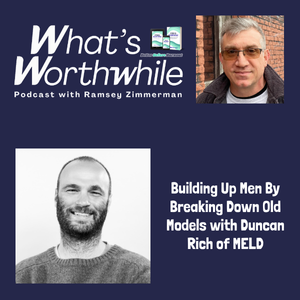
[00:01:40] Speaker B: Hey there, it's Ramsay here. That was Duncan Rich. Duncan is one of the founders of meld, which stands for Men's Emotional Leadership Development. He's a pretty interesting guy, used to play in a Prague rock band, travel around in a vegetable oil powered bus and eventually got into planning and hosting special events. Speaking of events, since the day we recorded this interview, I registered for his and Meld's upcoming retreat taking place at Joshua Tree in California, February 19th through 22nd.
It's the Meld Prime 4 Day Science backed somatic retreat Training for men. At the end of the discussion we reveal a coupon code that will get you 15% off the price of registration.
So if you want to meet Duncan and me in person, listen on till the end.
I mean, I guess you could skip to that part, but that would totally be cheating.
So listen on to get a feel for what this is all about.
[00:02:37] Speaker A: Hey Duncan, how are you doing today?
[00:02:39] Speaker C: Good, Ramsey, how are you?
[00:02:42] Speaker B: I'm doing great.
[00:02:43] Speaker A: Thanks for coming out to hang out with me a little bit here today.
You are a father, an artist, a sustainability advocate, a former nomad and a co founder of meld, which is a somatic health and education group for men. And, and I got to say that right off the bat, the first thing I'm curious about is about how and why you were a nomad.
Tell me about that. What were you doing during your wanderings and what was that all about.
[00:03:19] Speaker C: Absolutely. Well, first of all, thanks for having me. I'm really excited to continue the conversations we've been having.
In my, let's see, early 20s, I played music in a band.
This would be in the early 2000s.
We had, we bought a school bus, 66 passenger, you know, 30, 35 foot school bus from the state of Connecticut. And we gutted it, took out all the seats, built bunk beds and put in some couches, the kitchen, a little office, some shelves and some other stuff.
And we converted it to run on vegetable oil so we didn't have to pay for gas or for diesel. And we lived out of that bus for a couple of years, sort of traveling all around for quite a long period of time.
And, and even before that and after that, I, you know, was a little bit anchorless in, in life.
Traveling around New England and the Eastern seaboard, painting houses, playing music, doing sort of lots of different odds and ends, just trying to see the world a little bit. And then.
[00:04:43] Speaker A: How many people were in the bus?
[00:04:46] Speaker C: Well, there were a minimum of four of us and sometimes up to 12.
So it was, it was a lot of fun. We made a lot of friends, met a lot of people, played a lot of music, you know, filtered a lot of vegetable oil and, and yeah, it was, it was a really good time. I, I wouldn't trade it for, for the world, even though it's not really a. It's not really available anymore. So I'm glad I, I had the experience when it was sort of prime time for, you know, alternative fuels.
[00:05:22] Speaker A: And that wasn't even biodiesel, huh? That was just straight up vegetable oil.
[00:05:26] Speaker C: Yeah, straight up vegetable oil. Most often, you know, we, we learn to find oil from sort of nicer Japanese, nicer Italian, nicer Thai, Asian restaurants. You know, less oil and, well, the oil's cleaner. The oil required less filtering. You know, if you go to McDonald's or, you know, Burger King or whatever the, the oil is, it's like, it's a solid. So we, we took as many steps back from that as possible and just tried to get the oil that started out pretty clean. And the filter system that we had went and filtered it again, you know, three or four times to just make it as clean and thin, you know, viscous as possible for the engine.
[00:06:14] Speaker A: What kind of music was it the band was playing?
[00:06:17] Speaker C: We were, at the time, we were sort of a prog rock, space rock band called Constance.
It's a lot of fun.
[00:06:24] Speaker A: Have you got any of that old stuff, like up online anywhere?
[00:06:28] Speaker C: I Believe it's. Yeah. Constance is up on, you know, Spotify, music streaming sites, Apple Music, Band camp. There's a band camp?
I don't know what it is. I haven't been in that band since 2009, but it's up there.
[00:06:44] Speaker A: Yeah, I'll have to go check it out.
But what, what kind of led you to start settling down?
[00:06:53] Speaker C: Well, that's a good question.
I wanted a little bit of stability.
You know, adventure was, it was really wonderful and I learned a lot and I gained a lot. And that's, you know, it's impossible to encompass sort of years of vagabondery in, you know, in, in just a few seconds. But it was really amazing. And I started feeling, I started, started feeling like I, my roots were, weren't taking into the ground at all.
I, I wanted just, I wanted, I wanted more from myself and more from life that, you know, was kind of just being lost in the travel, lost in the transfer, in, in, in transition, being in transition all the time.
So I went back to Boston, where I was from and you know, started working and using my music turned show booking skills, turned event production and started booking shows, started booking tours for bands.
And that led me sort of all over the place. I lived in Hong Kong for a year and a half with the person who's now my wife.
And we moved back from Hong Kong to Brooklyn where I started running some music venues and art spaces there, where I got more heavily into event production and did a lot, produced a lot of events, music festivals, roller discos, weddings, marketing events, I mean, all kinds of, all kinds of events for years and years.
And that brought me to creating a, an experimental sustainability conference.
So environmentalism, sustainability was always sort of top of mind for me and felt really important. Sort of like, why aren't we all sort of having these conversations about sustainability and making the world last as long as it can or making our time here last as long as, as possible.
And so I created this sustainability conference called One Fair, which stands for our new energy fair here in the Hudson Valley where I live.
And that took a sort of people centric view of sustainability where, you know, solar panels and electric vehicles and geothermal and all of that stuff is great, but what about the people who sort of don't have the safety enough to be focused on those sort of luxuries?
So I, I took more of an approach of like, what do people need to just start feeling better so they can then hopefully start approaching that feeling of connection with the earth and with each other and with this sort of global collective.
And that led me to the work of this, my now business partner, a man named Owen Marcus, who is doing somatic body based men's work. So helping men sort of reconnect with lost parts of themselves or you know, removing the sort of detrimental parts of these protective patterns that we form, that our nervous system forms for us in early childhood and, and then throughout our lives and getting those protective patterns that aren't serving us anymore sort of out of the way and bringing more of who we really are to the table. And he was working for a company called Everyman at the time.
And Everyman, you know, the work of Everyman was sort of based around the work of Owen Marcus and a few other people.
And I started working for Everyman. I started producing the retreats and the events for Everyman and that.
And I sort of just grew deeper and deeper into that organization until almost two years ago now. Owen and I and our colleague Mike Sagoon, a few other guys, we left Every man and we started Meld.
And where we.
[00:11:47] Speaker A: Seems like a real progression for you from, you know, being out seeing the world in your bus playing music to, you know, starting to organize events that, you know, events that presumably you are participating in this whole time in one form or another, but now you're kind of organizing them and then also, you know, going from exploring your, you know, thoughts around sustainability and around renewable energy.
That all resonates with me. I spent a lot of years in the renewable and sustainable energy space also.
Um, but then realizing and understanding that, you know, it's almost like Pavlov's hierarchy of needs, right? It's like if you don't have the, the basic fundamentals, then it's hard to even make your way to the alternatives unless because we've gotten in this world that we're in so kind of far away from sort of the basics of natural energy flows and you natural whole foods that you have to make an effort to find your way back to that stuff.
But it's interesting that, you know, getting to that idea of having people be sustainable and people being healthy and it's great to look outside and beyond ourselves to the health of the world. But in some ways that almost feels like a luxury if you can't see beyond it.
And how do you think, I mean, how do you think men today are kind of challenged and kind of wired up in this place of, you know, things are kind of fundamentally different than they were, you know, five, 10 years ago?
And kind of as we were growing up what do you think some of those.
[00:14:13] Speaker B: What are.
[00:14:13] Speaker A: What are some of those big challenges that you and your partner were beginning to address as you were forming? Meld?
[00:14:23] Speaker C: Yeah.
Well, I think men.
Men have sort of been handed this paradigm of what being a man is that is actually fairly limited. It's extremely limited, actually.
You know, we have been told that being a man is to be all of these things, but none of this, you know, to be strong, to be, you know, the roof over everyone's head, to have all the answers for everything, to do it by yourself, to come. You know, if you. If you ask for help in any of your pursuits, then you haven't come about them honestly. So you have to, you know, do it alone. To not really share your struggles or, you know, look for. Look for help or support when things aren't feeling good.
Kind of not really addressing how you feel very much at all, actually.
And it's very lonely.
And, you know, there's talk about this, you know, male loneliness epidemic. I think the loneliness epidemic extends beyond men, given the digital state of everything.
But as it pertains to men, you know, the. The changes that we're sort of. That we're addressing, they haven't, you know, there's.
There's a constant evolution in culture and society. The changes that we are looking at are more. Are older, sort of like when we stopped being a community, when we stopped, you know, doing things tribally, so to speak, like when someone is sick in the village, for example, like, that affects all of us. And so we all come together to do what we can do to help that person get better. Because we're all interconnected and we're all interdependent. Now. There's such a emphasis put on our independence that it. It makes. It really. Makes it really lonely. And that's actually not a way for most people to thrive. We need each other. We evolved together, like, biologically over millions of years. We evolved in community. We evolved having each other's backs and having someone have our back. And so this isolation that we're living in now is not really. It's not natural. It goes against our biology.
So the work that we do kind of challenges the dominant paradigm of you have to, you know, be. You have to be everything to everyone, and you can't complain and you, you know, don't have. And don't let anyone know about any of your problems and.
And do it all by yourself, you know, so our. Our stance is.
Is not that, you know, men are not broken. We're not bad. We're not wrong. We're not like, defective. It's this model that we've inherited that is counter to what our bodies want and need that we have to, you know, we have to do away with this model. But how do you move into something else when you have been trained in this, you know, in this paradigm? So what we and what we offer is that other path. It's somewhere else to go.
It's another way to view the world, and it's another way to.
To show up that is different from this pattern that has been handed down generation after generation.
[00:18:19] Speaker A: And what does MELD stand for? What does the name mean? And what are, you know, some of those fundamental approaches that have that break down that other paradigm you're describing?
[00:18:33] Speaker C: MELD stands for the Men's Emotional Leadership Development.
It comes from a training that we used to do called the Men's Emotional Leadership Training that my partner Owen invented.
Excuse me.
And what we do is we work with the nervous system, so we work with the body, we work with your physical experience, and we help men get out of their heads and into their bodies and become more embodied. So when you have an experience of any kind out in the world, even at home, wherever you are, first on a. On a, you know, physiological level, on a biological level, first you have a physical experience. When something happens, your body is first to respond. Your body is on the front lines then. And this happens in, you know, a split second.
But then you have an emotional experience. Your emotions respond or they react involuntarily, and then you have a cognitive, intellectual experience.
But with our bodies on the front lines, we end up, even still, we end up sort of dictating everything from the mind and thinking about what we should do and deciding and, and that's all great. And the mind is incredible. It's an incredible, incredible tool.
It's only really one avenue of exploration, though.
And the mind is then subject to our patterns, our belief systems.
It's subject to a lot of.
A lot of patterns that we have created because of stress and because of threat, you know, being in the threat response. So when we say we work with the body, we work with the unconscious, we work with what is underneath that sort of intellectual experience, what you think you should do.
And we, we help sort of short circuit some of these protective patterns that we've developed from a very young age that, you know, that come from a place of survival, right? They come from a place of needing to survive. So you shut down in order to survive, or you blow up in order to survive. Or you. You flee. A lot of this comes down to your fight, flight, freeze responses and how those showed up in the environment that you were raised in.
And so in order to avoid discomfort and to avoid pain, the. The body starts to create patterns around avoiding these uncomfortable feelings and these uncomfortable or incomplete, incomplete feelings. Like, you know, this didn't get fulfilled for me. So I'm going to.
I'm just. I'm going to avoid it. And this isn't a conscious decision that we're making. This is totally, mostly, totally unconscious. And so the way that we work at MELD is to get into those unconscious realms.
Access. The access point is the body, you know, the sensations that we all have access to. You know, we all have the ability to, you know, touch into this wisdom that is just sort of living in our bodies. Our ability to.
Our ability to listen and to understand what's happening in our body has eroded because of practice. You know, we haven't practiced this at all. It's not something that's been encouraged in men especially.
But we're born with these skills. We're born with these skills of expression, of processing, and they just get eroded by life and family and stress and culture and society and trauma.
And so what we do is we create essentially a safe space for you to go in and reconnect with those things that have been offline for sometimes decades, sometimes almost your entire life.
We get men in their 30s, 40s, 50s, 60s, 70s, 80s that come to us, and they are remembering, experiencing things that they never thought they would be able to experience again. They're remembering things from early childhood that really put them on a path for where they are today.
And bringing awareness to that allows you to come in and start rewriting some of those patterns and some of those beliefs about the world and about yourself and about what you're capable of.
[00:23:49] Speaker B: Look, we all deal with stress. Stress is not the problem. The problem is. Problem is that our body's innate stress response is built for physical challenges instead of the mostly mental, emotional, and virtual stresses that we face today. In my book, Stress Response, you'll learn to manage your response to stress in order to reduce anxiety, avoid burnout, and find calm and steady focus. The ebook is available on Amazon and only 99 cents for unlimited time. After you download, please don't forget to leave an honest review and rating so that others will find it too.
[00:24:26] Speaker A: So what kind of. What are some of the formats that you use in order to work with men?
[00:24:33] Speaker B: What.
[00:24:33] Speaker A: What's sort of the context of that? What is it what does it look like?
[00:24:37] Speaker C: Absolutely.
We do, we do one on one coaching. Both my partners and I work with men one on one. We have a program called CORE, which is a 10 week online men's group where my other partner, Mike Sagon is an incredible facilitator of this work, does, walks you through creating your own men's group with a group of guys, practice our format for sitting in a men's group and then teaches also about the nervous system and about our methodology. Because men, we like to understand, we like to know before we can trust.
So we provide the science of what is happening in the body. Under stress, under threat, you know, at peace, at rest, in, in all different kinds of circumstances. We teach about what's going on, we teach about why things have led the way that they have and you know, how you got here and, and then we practice and we put the work, we put the work to, to your nervous system and you get to start rewriting your, your patterns and your beliefs and, and then you have a group of guys that you are connected to for, you know, the rest of your life because you've shared some pretty deep experience with them. That's a program called core. We run it a few times a year.
[00:26:10] Speaker A: Is that virtual online or is that in real life?
[00:26:15] Speaker C: Yeah, that's a virtual program.
It meets once a week for 10 weeks. We have another virtual program that is a deep dive intensive group coaching, small group coaching program that is run by Owen Marcus, my partner.
It's 12 weeks and that is much more personalized. Who are you? Where are you at, what are your challenges, what are your goals, what are your aspirations, what's holding you back today? How are you?
That kind of thing.
We seed men's groups off the back of all of these programs and we also have resources for starting and maintaining a men's group that, that uses our method in practice.
We write group guides every week. We release a new group guide on Sunday that, you know, groups all over the world can use and use in their weekly meetings.
And then we also have in person retreats that are four day trainings where we get together usually somewhere beautiful, always somewhere beautiful.
And we sort of unwind from the pace of regular life. We slow down, we spend a lot of time in this space of connection and training and we, we, we sort of explode the methodology. We walk you through step by step. It's an experiential training. All of our trainings are experiential, which means you use your nervous system, you use your life, you are very much Doing personal growth work while also developing skills that you can then go take with you and use for the rest of your life.
The people mark their lives by their first meld retreat. They really, really are game changers for people because you come away with a whole new perspective about yourself and your abilities and as well as some practical skills that you can then go and put to use in daily life.
And we have one of those coming up in February in Joshua Tree. It's going to be really nice.
[00:28:38] Speaker A: Yeah, Joshua Tree. So that. In February. So that's coming up really soon here. Yeah, tell us more about that. So you said it's four days.
What happens during those four days?
[00:28:54] Speaker C: Yeah, so we eat really good food, we spend a good amount of time in nature because nature is incredibly restorative and healing.
And then we, we teach the method, we teach the methodology to the big group. We practice in triads and small groups. Every single person gets to try out every step of, of the method.
We have some processes for men who are ready to do some really deep work and really, really deep pattern reorganization.
And.
[00:29:35] Speaker A: Are there any prerequisites like do you have to, to have been through anything before or do you need to have some background or is it pretty self contained?
[00:29:45] Speaker C: Yep, you can. We, we get guys in off the street all the time.
We also get therapists and coaches who want to learn this method and use it in their work.
We get entrepreneurs, we get first responders. We get guys kind of from all over the map and all over of all spectrums.
[00:30:06] Speaker A: So what are those, what do all of those people have in common? Like, if you get such a wide range of different guys coming to this, like, who is it for?
How does it, what do they all have in common?
[00:30:19] Speaker C: Yeah, usually what they have in common is that they've tried, you know, more traditional therapy, or they've tried meditation or coaching or, you know, this or that. Different, I don't want to say modalities, but different sort of techniques for personal growth. And they know that there's more, but they have sort of hit a wall.
And I mean, that wall that they're hitting is actually like those are the limits of this limiting paradigm that we're talking about. So we have to kind of extract ourselves from out of that. So something that a lot of these guys have in common is they've done some work, they've read books, they, you know, they follow people, they listen to podcasts, they, they put things into practice and they're, they're ready for more and they're looking to they're looking for something that sort of clicks a little bit more, that is a little bit more intuitive, a little more natural. Works with, you know, works with the body's natural, you know, imbued wisdom.
So.
And, but aside from that, you know, we get guys in their 20s, all the way up to their 80s, we in all kinds of professions, artists, retirees, medical professionals, you know, struggling to think of something that you mentioned that we don't get.
[00:31:56] Speaker A: Use the word training a lot.
Are, are they training so that they can help themselves or are they training so that they can help others like clients or peers or family members? Or is it a combination of both?
[00:32:12] Speaker C: It's, it's a combination of both. I would say. Most guys come to us to help themselves and we do get a fair amount of guys who come to us that they're coaches, they've heard of us, they want to start weaving in our methodology into, into their practice. Great. The retreat is kind of like cracking that door open, getting some real hands on experiential experience with the training or with the, with the method, with the methodology, with the steps of it, using it, and then starting the journey with these tools in the tool belt.
After the retreat, we have a training called the, the integrated training, which is much longer. It's a hybrid online in person and it, you know, part of it comes with a professional certification where you could become actually a certified male men's work facilitator that we, that we've done an equivalent program of that three times and we're looking at doing our first one as meld starting next year. So. But the retreat itself is kind of the, is the prerequisite for that training. But in order to come to this training.
Sorry, in order to come to the retreat training, there's no prerequisite, only a desire for, for growth and to, you know, you have to be ready to lean in and do the, do the deep work to get the change that you want.
[00:33:48] Speaker A: What kind of transformations have you seen and what kinds of transformations have your clients sort of described as a result of going to these trainings? Like what are some of the things that, the issues that they were facing which they had a, just a completely different perspective on or breakthrough as a result of going to the, to these retreats?
[00:34:13] Speaker C: Yeah, that's, that's a great question.
I'd say if I had to sort of pick the major buckets that guys come to us seeking transformation, so to speak, in there, be like relationship, my relationship, my marriage, my relationship with my kids is you Know, it's distant or it's falling apart.
You know, I feel sort of stuck between a rock and a hard place. I need something to change.
And these guys, you know, we have some testimonials on the page, actually on the retreat page of some guys talking about, you know, how their relationship has changed as a result of this work.
Being able to show up as more of yourself, being able to show up sort of more courageously and more fearlessly and. And setting boundaries where maybe you haven't set boundaries in the past. That's a big one. A lot. We get a lot of nice guys, recovering nice guys. I'm a recovering nice guy myself.
We're sort of putting myself last on the list and taking care of everyone's needs, everyone else's needs first, and then not having really any energy or, you know, vitality left to nurture myself and just kind of going along with that for as long as. As we can.
And it reaches a breaking point. And then we want to get you before you get to the breaking point. When, but when, if you can see that something needs to change, then we encourage you to join us. We get guys, a lot of guys who have retired and are sort of like, oh, my God, who am I? What do I do now that I don't have this job? What do I do now that, you know, I grew, that I had a very successful business.
I, you know, was responsible for so many things, and now I am kind of at a loss for what my next step is. We do a lot of transition, like, what's the next step for guys?
And then we get a lot of guys who are looking, just looking to be more somatically or emotionally aware. It's like, who don't want to be at the whim of their reactions. They want to sort of know how they're feeling in the moment and be able to have some agency, be able to respond instead of react instead of. And so some of the transformations that guys see are like a broader window of tolerance, greater range of resilience. So more and more events and experiences trigger less and less stress, and you're able to sort of down regulate yourself under a broader array of challenges and then work through them, you know, accordingly.
And I mean, you know, I could go. I could go on and on, but it really, it's. It. It's a game changer in your personal life, just solo with yourself. It. It changes your relationship to work and. And purpose and. And fulfillment, pulling fulfillment from work.
You know, we get a lot of guys who have Sort of, you know, I checked all the boxes. I, I grew a successful company, I have this family or, you know, I had a really good job for a really long time, but I just don't feel the fulfillment. I don't feel that satisfaction.
I thought there was going to be more to this. And so we help guys sort of unlock that. We help men unlock that for themselves.
[00:38:08] Speaker A: No, this sounds really, really fantastic. I think I want to go.
[00:38:14] Speaker C: Yeah, we're going to get you there.
[00:38:16] Speaker A: Yeah, I, you know, I speak to and I, I do work with men who are, you know, really just doing their best and showing up at work and, and trying to be successful and showing up at home and trying to connect with their families, but they're just struggling sometimes. A lot of guys are just struggling and we don't even necessarily know why.
And there's probably a whole host of factors, and I think you described a lot of them. And oftentimes I look at just the real basics of taking care of ourselves and, you know, eating, you know, nutrient dense whole food and sleeping well and managing our stress the right way and, you know, all the things that you're talking about. And I think that it sounds to me like this retreat is just right in that same alley, you know, right in that same lane of getting in touch with kind of what is actually going on inside our minds and bodies and spirits. Because it, it's like everything there is just completely interconnected. And I think so many of us of this generation, of this age sort of grew up and we were encouraged to just push through and just, um, you know, it's fine, I'm fine, everything's fine, you know, and.
But now we're getting to realize that we can't do everything and we are starting to slow down and, you know, we can't lose our edge. Like, I, I think of that window of, you know, you need to get better before burnout sets in and really strikes and hits you.
And it really sounds like you're creating a space and a time and a place and a resource where guys can, can really tackle that head on.
So what do you think? How about a nice little discount code for those of us listening on the podcast?
[00:40:32] Speaker C: Oh, yeah, absolutely. Yeah, I'll get you guys a discount.
Well, you, you decide what the code is, and we will, we'll set it up so your listeners can get access to like a 15 discount on their retreat registration. We'd love to have you guys there.
You know, that, you know, a lot of guys we, like, a lot of us are Struggling. And it's, it's like taboo to say that you can't really talk about that, especially in certain circles, you know, like the problems of men, like. What do you mean? Like, men are responsible for all the evils in the world and all that. And it's, you know, it's not the men. The men are not the problem. The model that we've inherited is the problem. And it's time to change that. It's time to step into something new. And the kicker is you get to feel better.
And then when you feel better, your family starts to feel better and your, your closest circles start to feel better and start to do better. And then, you know, it's like the cells of the body, when each of the cells of the body starts just waking up and feeling better and feeling healthier than the body as a whole, starts to feel better as well. So like when a man feels better, that has a ripple effect. When a man feels better, he starts to do better.
And we all want to do better. That's, that's really the only thing that we want is to be able to do better. And we get to and, and show up for our families and show up for our passions in life and, and just be happy and feel fulfilled doing that. And when you get to do that, the ripple effect is really palpable. And if, you know, in think of a world where like all, you know, many men start to bring these parts of themselves back online, that's. We're looking at a completely different, you know, kind. We're looking at a different world. I think so, yeah.
[00:42:39] Speaker A: I mean, it really feels like part of the solution. I mean, traditionally, you know, the father has been looked at as the leader of the household. And you know, we have traditionally in workspaces.
Workspaces were sort of male led and times are different, times are. Times have changed. And we now have, you know, female leadership also. And I completely, 100% support that.
But when guys sort of get the vibe that, you know, masculinity is toxic or can be toxic, I think that that can lead to some really negative self talk and self images that men can have. And they're, you know, don't throw the baby boy out with the bathwater in the sense that there are, there are still ways in which masculinity can be extremely helpful and productive. And, you know, that form of leadership is, I think, really important and tradition and terrific in society. We just have to sort of do it right. And now we have to sort of understand what our place is for that. And I just really appreciate the kind of work that you're describing to do that for, you know, our generation, my generation, and also the generations coming up. You know, the guys who are becoming men now need to know and understand how they can support themselves and be healthy and be productive and support their families and future families and their community going forward. Like, we need. We need solutions and.
[00:44:36] Speaker C: Yeah, that's right. And we learned this work. We do. I'm doing this work now so my son doesn't have to do it, you know, and we get to.
We get to be the shift in the model. So that the model that my son and that our kids have to look up to includes this, you know, includes this kind of approach.
And it's more than just the sort of traditional, like, you know, just power through, bang your head against the wall.
You know, it. It is much more nuanced. You know, the time times have not gotten less complex. Things are getting more complex.
You know, it requires a complex approach. It requires complex men and adding or sort of reawakening these, you know, complexities are.
You know, it's so much. It's so much closer than you might think, because these are all. We're born with, these skills. They've just been eroded. We have to reawaken them. And once we do that, then the younger generations, they start learning from us more organically, naturally, and it just. Naturally, we start passing on something different.
[00:45:58] Speaker A: Well, how can.
Where can people learn more online? How can they learn more about Meld and find the information about the retreat coming up?
[00:46:09] Speaker C: Yeah, absolutely.
Our website is Meld Community. M E L D Community.
The retreat is meld.community prime. It's the prime retreat.
And you can find us on Instagram.
Meld men.
We're on LinkedIn and Facebook and gosh, TikTok. And just everywhere, if you just look for us, you'll find us.
[00:46:37] Speaker A: And we'll have a coupon code, worthwhile. All one word, worthwhile. And that'll get 15% off on the event coming up on February 19th through 22nd in Joshua Tree, California.
Well, Duncan, this was so really great. Thanks for telling us all about that. I'm really excited about this event.
And thanks so much for coming out.
[00:47:08] Speaker C: Oh, thank you. Thank you. Thank you so much for having me, Ramsey. It's really nice to connect with you. I look forward to seeing you in February.
[00:47:15] Speaker A: All right, talk soon.
[00:47:17] Speaker B: Ready for more? Visit whatsworthwhile.net to listen to podcast episodes. Master your response to stress by reading my book, Stress Response, available through Amazon or to get better before burnout sets in by requesting the free guide. Regardless of where you are in your.
[00:47:34] Speaker A: Journey, I'd love to hear from you.
[00:47:36] Speaker B: And talk about how we might move forward together.
Please contact me, Ramsey Zimmerman through the website or on social media like Instagram, Facebook, LinkedIn or eggs.
[00:47:47] Speaker C: Thank you, Ra.