Episode Transcript
[00:00:11] Speaker A: What's worthwhile considering what we consume, believe, say and do towards peace of mind, vitality of body, and joy of spirit? I'm Ramsey Zimmerman. Here's some more healthy living motivation and discussion.
[00:00:31] Speaker B: I remember, you know, from my childhood that the. The food pyramid was really iconic. I grew up with that thing. I saw it all the time and it became part of embedded in popular culture.
[00:00:45] Speaker C: So we have the old food pyramid, we have the food plate, and we have the new food pyramid. There's a lot of people that would like to blame the old food pyramid and, and the food plate for all of the chronic disease that we see.
[00:01:01] Speaker D: We have now this standard American diet where it is packaged, fried, ultra processed, and lacking in nutrients. And as a result of that, we are seeing a disease cascade effect as a result of the lack of the nutrients in the foods that we're eating.
[00:01:22] Speaker C: The truth is, if you took the old pyramid and the old plate and ate whole real food, you would actually be in pretty good health.
[00:01:33] Speaker B: The new food pyramid, the slogan is Eat real food. They're just really kind of on the nose with that particular point.
[00:01:43] Speaker A: Hey there, it's Ramsay here.
That was me along with Dr. Carrie.
[00:01:48] Speaker B: Thuitt and Holly Mullen.
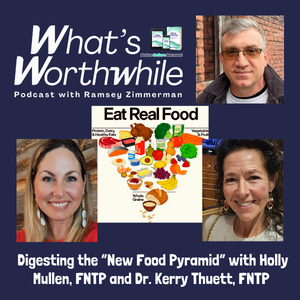
[00:01:50] Speaker A: Carrie and Holly are both experienced functional nutritional therapy practitioners and agreed to join me to discuss the new dietary guidelines that came out from the US Department of Agriculture. At least in the nerdy nutrition circles where I hang out online, it created quite a stir because they clearly deliberately flipped the old iconic food pyramid upside down. You remember the old pyramid, right? Did you realize that was retired years ago and we've had a couple of versions since then? So why is everyone getting all excited and why are a bunch of people getting mad? Well, it probably has something to do with it being embraced and cheerlead by the Make America Healthy Again, or Maha movement, because that's one side. But do we have to make dietary guidelines political? I was eager to have this conversation with two NTPs who are way more experienced than myself because I was looking for perspective and I think I got it now. I'm excited to share this conversation with you. Let's jump in.
[00:02:53] Speaker B: Hi, Holly and Carrie. How are you both doing today?
[00:02:57] Speaker C: Doing well.
[00:02:58] Speaker D: Hi. Hello.
[00:02:59] Speaker B: Good, good, good, good.
So wanted to thank you both so much for joining me in this conversation today about the new dietary guidelines that are coming out of the U.S. department of Agriculture and Department of Health and Human Services. And also just about the the Make America Healthy Again or Maha movement more generally.
But before we dig into the topic, let's do some introductions first.
Dr. Carrie Thuitt, you're a PhD toxicologist, a functional nutritional therapy practitioner.
Um, you're a strength and conditioning trainer and behavior change consultant.
Tell me, what does all that stuff mean, and what is your sort of interest and background here in the health space?
[00:03:54] Speaker C: That's interesting. So I have various science degrees, and when I went to work as a private toxicologist in San Francisco after my PhD in actually neuroscience and toxicology, I discovered that the system was broken. I discovered that academia was slightly off, that industry was slightly off, and that government was slightly off. And they kind of worked together, not intentionally, but together, to promote dis health.
And so that's when I quit that job as a private toxicologist to actually make people healthy, instead of reading people's medical records and letting them file lawsuits because they were unhealthy and blame it on somebody else. And so I started my business Fully Fueled Fitness and went to the Nutritional Therapy association for my nutritional education and then Strong first and various other organizations for my strength and conditioning. And I put them all together because I believe that to be optimally healthy, you have to move well, eat well, behave well. Right. And so I put it all together, and that is how I run Fully Fueled Fitness as we hit all of those areas.
[00:05:24] Speaker B: Wonderful.
And, Holly Mullen, you are also a functional nutritional therapy practitioner.
In addition to doing the nutrition work, though, you focus a lot on the built environment and healthy homes and real estate. Can you tell me more about that and what you're doing and how those two things are connected? Real estate and health?
[00:05:53] Speaker D: Yes. So I've been in the holistic health space for just over a decade now. And when I started my functional nutritional therapy practice in 2019, I was working with people who were very sick. And as the years went on, more and more of our conversations kind of grew. It was no longer addressing just your food or your foundations or what was going on with your lifestyle. It was more questions about what's going on in your home environment as things were not getting better. And so we just started having more and more conversations about what's going on in our living environments, home environments, work environments. And so my business just kind of transformed into real estate, talking about the living environment and how our light, our noise, our land around us, the chemicals and products we use, the water, the air we breathe, all of those things also impact our health. So even if you're eating the most nutritious, perfect diet and exercising and doing everything else right, if you have other factors working against you in your living Environment, it could be the things that are keeping you stuck. And so that is the realm in which I mostly work now.
[00:07:28] Speaker B: That's great. So it strikes me kind of off the bat that each of you have taken sort of a very different sort of stance and interpretation from the status quo. You know, in the sense that, Carrie, you sort of had the. The status quo science and Holly, you're looking at sort of the status quo of housing. And neither one of those were really up to the task.
[00:07:55] Speaker A: But now, as we start to think.
[00:07:57] Speaker B: About food specifically and about, you know, what people are recommended to eat, why don't we start with the idea of what is it about the standard American diet, if you will, that has been sort of promoted historically, you know, over the last 10, 20, 30 years, you know, what is it about that that is really not what we as ntps, really think that people ought to be eating? And which one of you would like to kind of jump in there and go first?
[00:08:42] Speaker D: Sure.
So the Standard American Diet, maybe for people not listening, the sad diet, it's kind of just evolved over the years as our modern lifestyles have evolved to be busy and on the go, we have turned more to foods that are quick and convenient. We've seen this big growth in eating foods that are drive through, eating out more in restaurants, more packaged foods. Where traditionally we had more meals prepared at home, it was a lot more slow. People grew their own food.
And so we've moved away from a lot of the traditions that our ancestors and even just great grandparents, the way that they used to eat, the foods they used to consume. And so we have now this sad standard American diet where it is packaged, fried, ultra processed and lacking in nutrients. And as a result of that, we are seeing a disease cascade effect as a result of the lack of the nutrients in the foods that we're eating.
[00:10:04] Speaker C: So let me add to that.
So we have the old food pyramid, we have the food plate and we have the new food pyramid. There's a lot of people that would like to blame the old food pyramid and the food plate for all of the chronic disease that we see.
But the truth is exactly what you just said, Holly. We began to become so needy of our fast food. And I don't mean junk food necessarily, but I mean quick and easy and convenient that because the truth is, if you took the old pyramid and the old plate and ate whole real food from those, you would actually be in pretty good health. Now you may have eaten a little bit too much carbs, so we have to pull that down. Or too little protein to pull it up. But if you took either of those and you ate it as whole real food, you wouldn't necessarily have health dysfunction. It is taking those recommendations and then turning them into fake food. Fast food, quick, easy, convenient, eat on the go.
That's a problem.
[00:11:20] Speaker B: Yeah.
And do you think that.
And so the, with the new dietary guidelines, they're calling it sort of the new, the new pyramid. The new food pyramid. The slogan is eat real food.
And it really, they're, they're just really kind of on the nose with that particular, with that particular point.
Did we see in previous dietary guidelines and emphasis like that on eating real food as opposed to processed or ultra processed foods?
[00:11:54] Speaker C: It did say real food.
I don't think it said it up front, but it did indicate that.
So they were not deficient in saying that. What they didn't do, though, is they did not define really what real food was.
And I think the common consumer assumes that if Sonic is selling it or the grocery store is selling it or Nabisco is selling it, that somebody is in control and it must be real food.
So I think even now it says eat real food right up front. I think we have a huge amount of the population that doesn't even know what that is.
[00:12:39] Speaker D: And the problem is, is that a lot of our food that looks like real food, like just take a hamburger, for example, looks like real food. It looks like bread, meat, lettuce, cheese. Those belong in food groups. But when we're ordering them from fast food places or on the go places, or when they're not made from home, from scratch, from ingredients, we are sourcing, they have additives, fillers, preservatives, pesticides, herbicides. There are so many other things added to it where even though it looks like real food is no longer real food. So the whole concept of real food is very confusing.
[00:13:25] Speaker C: It is. And another example of that is with I'm going to use whey protein as an example.
So we're told to eat our protein.
And many of my clients come to me and they say, oh, well, I'm eating a high protein breakfast. I put a scoop and a half of whey protein in my coffee every morning. And I go, oh, no, please just eat a piece of salmon. And they don't. And, and I don't disagree with eating whey protein as a strength and conditioning coach. There's a place for that.
But we've got the common consumer that thinks that they can replace a whole meal of meat with a scoop and a half of an isolate product.
And they think it's real food.
So it's not. So that's another example of what they think is real and what is not.
[00:14:18] Speaker B: Yes, well, the, so the new guidelines, they are, you know, sort of laid out in this graphic with a, with a triangle with different images. And I think that in a lot of ways the, they laid it out that way because they deliberately wanted to have the effect of flipping the old triangle, the old pyramid, for the sake of flipping the old pyramid because they're doing it on purpose to make a statement.
And I remember, you know, from my childhood that the, the food pyramid was really iconic. Like, you know, I'm 50 something years old, I grew up with that thing. I saw it all the time and you know, it was, it became part of embedded in popular culture.
Uh, and it led to the whole, you know, low fat, no fat sort of food craze that, you know, was very dominant for many years and decades. I wonder, do you think that the, the my plate or the other guide guidelines that were given to us in the meantime between the old period and the new pyramid, were they as iconic? Were they ever intended to be as iconic?
And does that sort of make this one feel or in actuality more significant because of that, the way that they're trying to be iconic again?
[00:16:01] Speaker C: Yes, because I actually sometimes forgot there was even a food plate, which is weird because we eat our food off of a plate, not a pyramid.
But there's something about, I think the stark lines in a pyramid I think are very, they're very eye catching and you know, there's a base of it.
And so yes, I think it was iconic and this next one is going to be as well.
[00:16:31] Speaker D: That's funny. When you said I for. I forget there was a my plate too. And part of me was thinking it's because I wasn't in the school age. I feel like when the, when the original food pyramid came out in the early 90s, like I was of school age and I remember that just being like hammered into our heads and I was out of school when the MyPlate came out. And so I think maybe the only reason I even heard of that is because of NTA and because of our, our work and health and nutrition. But if you aren't in grade school or you aren't in the health field, did anybody Even know what MyPlate was?
[00:17:11] Speaker B: I don't know. I don't. I tend to not think so, but maybe we'll have to ask some younger folks.
[00:17:17] Speaker D: Yeah, I don't. I'm pretty sure my kids don't know what it is.
But they do know that pickles count as a serving of vegetable if they go through the lunch line.
[00:17:27] Speaker B: Yeah. And ketchup too, right?
[00:17:29] Speaker D: Yes.
[00:17:32] Speaker B: I feel like the only thing that iconic I can think of around food is like Michelle Obama and school lunches. Like I think that was pretty significant and iconic.
But so.
All right, so can either or both of you sort of give me a, give us and the listeners a rundown of basically what the new guidance is telling us, some examples of what the new guidance is telling us and sort of the, the big picture of it.
And then also I'm interested sort of in why don't we point out some areas in which it really is, you know, significantly different from previous guidance.
[00:18:19] Speaker D: Yeah, I'll let you take this one.
[00:18:21] Speaker C: Okay. So typically, because in the US we read right to left and we typically are top to bottom, the way this is going to be perceived is that you've got protein, dairy and healthy fats in the top left corner. So that is where people are going to put most of their emphasis. And I think that's how it was designed.
So we are increasing the protein level from 0.8 grams per kilogram body weight per day up to 1.2 to 1.6.
I like this.
People don't understand that the original RDA was the amount of protein that you needed not to die or not to get significantly sick. It wasn't a protein amount that was good for actual health and vitality. And so now we have far better numbers on that. Now we're at more like let's change it to away from kilograms.
If you weigh 140 pounds you're going to need to be eating between 76 and 102 grams of protein a day, which is at least two nice palm sized chicken breasts. I have my clients eat more like three. But so we're going to have much better protein.
And the thing is if you look at the pyramid, that protein is at the very top and ideally you should move straight over and go to fruits and vegetables, which it's how it should be. But if you also, if you look at the list that they gave, they're actually putting the full fat dairy before the fruits and the vegetables.
So I'm not as in favor of that. But that's the layout. The protein, the full fat dairy, then your fruits and your vegetables, then your healthy fats and then at the end or you've got your whole grains.
So that's the basic layout.
They talk a Little bit about. And it's not on the pyramid itself. It's in their list. They talk a little bit about processed food and, and added sugars, and I appreciate that.
I wish also they had mentioned added fats as opposed to fats that are inherent in food.
And so because people are going to be pouring butter on things, people are going to be pouring oil on things because they think they can now. But the truth is, if you're eating full fat animal, you're going to get almost all the fat you need. And you just need to supplement with a little bit of, you know, avocado and coconut.
The other thing is the alcohol. They left alcohol in saying, okay, we understand that you need alcohol for your social events and your free time, but we know that alcohol is highly toxic and we know that it has no benefit to health at all. I wish they had made a little stronger statement on how toxic alcohol really is.
Just a little example of that.
A beer in a male will drop his testosterone for 24 to 48 hours.
So anyway, that's just an example of, you know, why I wish that there was more about the alcohol. And I love the warning to vegans and vegetarians.
They do get very deficient in vitamins and minerals pretty easily.
If they will do it as whole real food, they will be less deficient. But if they need to understand that, they very clearly need to source their foods well and then supplement properly. And that is addressed in the guidelines. So I appreciate that.
[00:22:25] Speaker B: Holly, what did you think? How well did the new guidelines line up to, you know, what we promote as ntps?
[00:22:34] Speaker D: You know, I honestly did not go through it with a fine tooth comb. I saw that it was flipped and I said, you know, that's better than what it was.
To me.
I still feel like we're missing so much of the conversation of I. I just wish that we would talk about more bio individuality. And I know that not a lot of people know what that word is. We know what that word is because we studied it in our school and it's the foundation of what we do with nutrition. But there is so much nuance when it comes to what people should be eating.
And it's hard to generalize it. And I know when we're speaking to a very broad population such as the United States, it needs to be generalized. But I wish that we, the conversation could shift more into talking about tailoring your nutrition for your needs and activity levels and goals. Instead of just being like a blanket, you should eat this and then these amounts and avoid These across the boards. I, I wish there were, there would be more nuance brought into the conversation, but I guess I can't pay for that.
[00:24:02] Speaker C: I agree with that.
I actually took that for granted when I made my statement earlier because it's so ingrained in us that we, we feed the individual. We don't feed a population.
And so in my practice, I tell people that we, number one, we look at your genetics and then we look at what your current health status is, what your lifestyle is, you know, how, what is the life that you lead and what kind of food can we fit into it?
And, and what is your personal biochemistry? What is your personal biology? Because there are generalities on how the human body works, but everybody is slightly different. And that's what bio individuality means, is that one person may be able to tolerate based on their genetics, their lifestyle, their activity level and so forth.
Let's say a hundred grams of carbs a day, another person may have to drop that to 70 or they're actually become diabetic.
And so we have to, yes, there needs to be talk about that for sure.
[00:25:13] Speaker A: Look, we all deal with stress. Stress is not the problem.
The problem is that our body's innate stress response is built for physical challenges instead of the mostly mental, emotional and virtual stresses that we face today. In my book, Stress Response, you'll learn to manage your response to stress in order to reduce anxiety, avoid burnout, and find calm and steady focus. The ebook is available on Amazon and only 99 cents for a limited time. After you download, please don't forget to leave an honest review and rating so that others will find it too.
[00:25:51] Speaker B: Yeah, well, you know, I think if we're talking about the, the general population, people are not going to dig into the 10 pages of written details of the recommendations. They're just going to look at the cute picture with the clip art and they're either going to say, well, I like the clip art, or they're going to say, oh, I hate the clip art. And they're going to say, you know, why is the stake so big? And you know, what happened to, you know, this and that and the other? Because that's going to be the level at which we talk about that. But it strikes me that it actually, you know, I've, I've been on social media a bunch and you know, I imagine we're all kind of in our own little social media circles, but it's fun to watch the constant goings back and forth between the carnivores and the vegans because You've got, you know, two completely different perspectives about what we should eat.
And the. They both are fairly well represented on this new triangle. I've seen several images where they're like, I'm gonna make my own triangle. And my triangle is gonna have, you know, pork and beef and bacon and chicken on it. And then other people's triangles are just with the. With the plants and legumes and beans.
[00:27:17] Speaker C: If you. If you look at that triangle, only a third of it are animal products.
So it is not a carnivore diet.
Only a third of this is animal product.
And so then if you then look at it from a meat standpoint, a fifth of it is meat.
So it's not carnivore, but it's also not vegan either.
And also with the healthy whole grains, they're small down here for sure.
But what you cannot see from the visual is that when we, as nutritional therapy practitioners are looking at grains, not only are we looking at whole grains, but we care about the fermentation process and making that bread a loaf of sourdough and optimizing health that way.
And so that needs to be in the dialogue, for sure.
[00:28:29] Speaker B: Yeah. A jar of kimchi would have been a good addition.
[00:28:32] Speaker C: Yes, there were.
[00:28:33] Speaker B: There's gotta be a kimchi clip art.
[00:28:36] Speaker C: Yeah. And that is not. You're right, it's not on here, but they talk about the fermented vegetables, but you're right, nobody's gonna read that list.
[00:28:43] Speaker B: Yeah. So I think where. Where the.
The actual written parts, where that's significant is where it's going to be guidance to larger institutions like public schools and hospitals and, you know, prisons and retirement communities, places like that, which sort of brings us to things like the institutions and just the whole notion that.
All right, well, this is coming out of the government.
Right. And we all know that the government is here to help us.
You know, Holly, what do you think about that? Like, is this sort of the. Is this the role. Is this a good role of government? Is this a good thing that the government ought to be doing, telling us kind of how to eat and sort of framing up and, you know, influencing how, you know, large swaths of the population, you know, eat?
[00:29:46] Speaker D: I feel like maybe we should balance a checkbook first, but.
[00:29:52] Speaker B: Yeah.
You know, do they even still have a checkbook? You know, is it just.
[00:29:58] Speaker D: You know, I was just making it funny, but.
No, but going back to.
I don't remember if I said this when we were speaking beforehand, but I understand that people are looking for guidance. You Know, if. If we're kind of looking at the government as our. Our parental figures, for lack of a better term, a lot of people are looking, looking at our government, thinking they have the best scientists, they have the best data, they know what is best and how to best guide us.
What should we do? Because people are seeing that we have a growing number of disease and sickness, and people are wanting answers and solutions, and the first place they look is to the government. What should we do? That is the first place people look for help. And so we, whether we as individuals want that help or not or ask for it, the government feels like they're in a place that they need to offer it and provide it. And so this is an avenue in which they do that. And I think this is a step in the right direction. They're making corrections. And this does shape policy, like you said, for school lunches for our health institutions and hospitals. And I don't know when the last time you've been in the hospital, but it is atrocious what they actually feed people that are sick in the hospital. And so if this can have any kind of impact on improving that, then, I mean, I have to support it.
[00:31:52] Speaker C: I would prefer that the government not tell me how to eat. But I understand that what you said about people want to be guided, and many people do.
What would be good in my ideas is that for an institution that receives government funding, that puts them in a certain category, they get government funding, therefore they have to follow more government rules.
I would like for institutions who are not funded by the government to be far more free to make their own decisions, even if it is different than what the government has recommended.
I would like the government to make the recommendation, not the rule.
And so therefore a private school or private hospitals, so forth, make your own decisions based on sound science, even if that looks different than the government recommendation.
I would like that.
[00:33:07] Speaker D: I do see that from time to time in the. Especially in private schools.
[00:33:15] Speaker B: That they're making choices independently, correct?
[00:33:19] Speaker D: Yes.
Yeah. That they can bring in outside food vendors.
Especially here in Tulsa, there's a big movement with, just like a grassroots movement with regenerative farmers and local growing organizations partnering with schools and hospitals. And there is a lot of red tape and restrictions with getting into the public schools, but with the private schools and some of the private hospitals there, they do have those relationships.
[00:33:54] Speaker B: Well, it's. It's interesting to me that somehow.
[00:34:02] Speaker D: Being.
[00:34:02] Speaker B: Healthy, encouraging people to be healthy became political.
[00:34:09] Speaker A: And it's. It doesn't.
[00:34:10] Speaker B: It feels to me like it shouldn't ever have needed to be political, but now we have Make America Healthy Again or Maha.
And that's a movement on its own that was sort of crystallized into being when RFK Jr put his support with Trump.
And you can tell that because it's, you know, because of the. The naming of the slogan, you know, in terms of it being Maha.
And now we sort of find ourselves in a place where it's political to, you know, try to be healthy or to say or think that the things that we were doing previously in America was, you know, less than healthy. But what do you think about that? Like, what kind of. When you think about a movement that.
What that became or was, you know, politically partisan, but now it's sort of moving into a space that ought not to be politically partisan.
Like, what do we do with that?
[00:35:26] Speaker A: What is.
[00:35:27] Speaker B: Where does that sit with either one of you? What are your. What are your thoughts on that?
[00:35:32] Speaker C: I cannot wrap my head around why anyone would connect health with politics.
Like, what they need to choose for their health. What does that have to do with politics at all?
And because it's just so separated in my mind, it's hard for me to understand how somebody would do it, but I know that they do.
With regards to the recommendation coming from rfk, yes, in half of the country's eyes, it's tainted because it's associated with Trump.
In some of that same population, it is tainted because RFK has questionable opinions about medical issues and medical treatments and so forth. And those two should be separate as well. And just because you may not agree with him on his stance for something medical, it doesn't mean that he hasn't put together a good team to explain nutrition.
It just. It just needs to be separate. What do we do about it? I do not know. I know what I do about it. I educate people one person at a time.
I would like to have a voice that could change more people, more. More people's lives at one time, but I don't. So I can only talk to one person at a time and say, this is the science.
This is your biology. This is what you need to do. Try it for four weeks. See how you look, feel, and perform.
At that point, they're bought in, and then they go tell somebody else. That is the only way I know how to do it, is change one person's life and let them go help change somebody else's. That's how we tackle it here.
[00:37:35] Speaker D: Well, and that's kind of the definition of a grassroots movement, you know, and that's really how Maha started.
I think before Maha was Maha, I think it was moms speaking up and pushing back against the government, interfering with health decisions. And so I think it has deeper roots than what it has become.
[00:38:11] Speaker C: I agree with that.
I forget about the term grassroots, but I, and I didn't say this about myself, but I used to weigh 300 pounds. I'm five foot two.
I now weigh 125 pounds. And I have, I lost that weight and I've kept it off for the last 15 years.
And it was 18ish years ago that I started hearing, hey, you should eat more meat. Hey, maybe your carbohydrates are a little too high. Maybe you should eat real food. And this is, you know, 18 years ago.
And it was so hard, so hard to find information on that.
And I. And it was grassroots. It was a few little people, Rob Wolf, Chris Kresser, you know, just a few other people that were talking about it. And so 12 years ago, this is what I started teaching my people to do. Basically, this inverted pyramid right here is what I started teaching people to do and changing lives. And it's interesting and great that now they've finally caught up.
But it's taken almost 20 years.
So that is a long time.
The government works very slowly.
[00:39:41] Speaker B: Yeah, that's a really good point.
That the information, I think especially previously, was really difficult to sort of come by and that we have a very different kind of consensus now around how we should eat and how much and how we should move in order to be healthy. And it seems like in many ways it's the, the government is sort of catching up with a consensus that we had.
But one thing that I always sort of think about in terms of government or politics, you know, when we. There's a lot of folks online who make a really good case that the original food pyramid was, you know, heavily influenced and created by special interests that, you know, the food companies that were making all that highly processed food.
And so now part of the movement that brought it in was a desire to sort of push back against that influence.
But now I, I read online just as many things saying that, you know, big beef and, you know, whoever big dairy is influencing the new and original or the, the new pyramid in terms of the guidelines. So now that it's in sort of that political sphere, it's now, you know, being criticized by, in the same ways, just coming from the opposite direction.
And then, you know, Carrie, you mentioned, you know, tainted having been, you know, associated with Trump or rfk.
Um, I've also seen online people making comments basically to the effect of, you know, it's, it's, it doesn't feel right or it doesn't feel appropriate for RFK to use language like saying things like the war on protein is over or the war on saturated fat is over.
When it seems like in other parts of the administration there's lots of war or aggression or you know, strong moves in that area happening. And then it sort of gets a sense of perspective, you know, in terms of the perspective of what is happening elsewhere in the administration that this is happening. And I don't know, it's like my feeling is that this is something good that's coming out of the administration. And you know, it's, it is in fact our federal government. And I would hope that we can see it as a national priority because it's coming out. But then, you know, is it, is it really.
[00:42:46] Speaker A: I don't know.
[00:42:47] Speaker B: Let me rattle on for a while.
[00:42:48] Speaker C: Let me kind of speak to two of those things separately.
All but one of the individuals that were on this review committee have, I'm going to use this term, ties to the beef, dairy and egg industry.
And that is going to be used against this pyramid forever. Okay? So.
And they, I want to help you understand though what the truth is there.
If I were to be on one of these committees, I would have to reveal everybody who's ever funded any of my research.
And I have a published author in peer reviewed journals from my PhD and master's research.
And I have been funded by the dairy industry.
I have been funded by, by the Department of Defense. I have been funded by semiconductor industries in Taiwan. I have been funded by Ford, GM and Chrysler. I was on the Johnson and Johnson and Depew hip implant litigation. I have been funded by Big Pharma.
Okay, if you listed that out, you would think that I was completely bought out. Because that's what they have told you to believe, that whoever is funding you is got you in their pocket. And that's not completely untrue. It depends.
But for research scientists, real research scientists, they have, they just want to answer a question and they don't care who funds them. They just need some money and they will do science and they will publish their results.
And if the peer, if your peers think it is good enough and that it is sound science, they will allow it to be published. Now there's problems with that too. That's a whole different podcast.
But just because all of these people at some point in their long, long career as scientists have beef Dairy or egg in their background doesn't mean they're bought out. Okay, so that's, that's one thing there.
Then the other thing you mentioned was.
Oh, I can't remember how you stated it, but it has to do with the political aspect of it.
The previous recommendations included health equity, and they were actually using race, ethnicity, culture, and socioeconomic status to help figure out what people needed to eat.
And the truth is, biology is biology.
And instead, what a human needs to eat is what a human needs to eat. And it doesn't matter if you're rich or poor or if you're black or white.
Your biology is your biology. And you need a certain kind of food. And so to tweak health recommendations based on political guidelines like race, ethnicity, culture, and socioeconomic status, it doesn't make any sense. This one is more based in biology.
So that is beneficial, that is good.
And the politics needs to stay out of our health.
And the more nutritional therapy practitioners we have who understand that, the better.
I wish there was a NTP on that committee. That would have been great.
[00:46:44] Speaker D: I do think it is fair to question motives too, though.
If we stop questioning, than anything goes. And like you said, Ramsey, like, the original food pyramid was not created because of the need for public health and for nutrition guidelines. It was created because of industry. And the agriculture industry had extra crops and they needed to unload them. And so that's why we have our recommended training, 12 servings of grains, because we had a lot of grains at the end of.
What was it, World War II? I don't know. And so for people to question, why are we now flipping this over? Is it, is it tied to something else? I think it is a fair question.
And there are bills. Like, we have a bill in Oklahoma that's the, the Food is Medicine bill.
And I will be honest, like, it makes me wonder, okay, what is this Food as Medicine bill? Like, as soon as we're labeling food as medicine as a political thing or we're making legislation around it, then that does give the government a wormhole to get in and tell us what we can eat, what we can to eat, and there are ramifications and how we live our lives once something becomes legislation. And so with the food pyramid, with legislation around, Food is medicine, as much as I love it and I want, like, I want to assume good intention, sometimes looking at the history and looking at why things are created and why things are not, I still have questions and I think it's fair that we question motives.
[00:48:33] Speaker C: You should question motives. And A personal example of that is when I was finishing up my PhD and I was trying to decide if I wanted to stay in academia or go into government or go into industry. That's basically your three choices.
I was told it doesn't matter.
They, I, they told me when I was looking for jobs. They're like, just get one. If you get into industry first, it's fine because what you'll do when you get into industry is, is you will get some background there, but then you can change over and go into government and they will hire you in government because you worked in industry.
And then they will hope that when you're in government that you will help out the industries that you worked for and, or if you get into the government first you'd go into government and then you change over and get into industry and you have ties there and they are connected and you can help each other out and academia is the same way. People will go into academia for a long period of time, get a lot of publications and then go either into government or industry and they bring all of that, those publications and those credentials with them and everybody knows everybody and everybody scratches everybody's back. And I shouldn't use the word everybody because it's not everybody, it is some people and it really does happen and you do have to question that is fair, but you can't question so much that you get to a place of unbelief.
So it's, it's two sided there.
[00:50:17] Speaker D: Yeah, I mean I think we are, we're at a place now where there's a lot of distrust with the public and there's a lot of confusion. I, I think the Internet and social media has led to that with the loud carnivore, the loud vegan. Like they're all the camps that are very loud, just contributing to the noise. And so people are confused, they distrust the information and they're confused about deciphering the information.
[00:50:51] Speaker B: That is such a great point.
Both of those were great points. So you know, in an ideal world where people are acting with best intentions, it makes sense that you would have transitions between academia and industry and government because of the expertise.
[00:51:14] Speaker A: Right.
[00:51:14] Speaker B: So you know, if everyone was acting with their best intentions, you would want decision makers to have a fundamental understanding of the science from academia and you would also want them to balance that with the, the practical knowledge of how the industry works from being in industry.
And then you can see and imagine how it's helpful to have people move, move back and forth and forth and back.
However, because we have the level of distrust and you know, when industry is driving, when the profit motive is the, the primary driving factor in not only the business decisions but also the government regulations, that's where you run into a big problem. And that's where you know, you talk about institutional capture in terms of when industry is driving the decisions and the actions and the policy making. And I think a lot of people would say that we've, you know, reached quite a large point of industry capture.
And that's where we get into the confusion because people don't know what to believe. They don't know and trust whether people are acting under the right intentions, best intentions, or how much they're being driven by a profit motive or a, you know, personal motive.
Within the, the world of government for power and you know, self advancement, um, you know, and those things operate in places. So, you know, where, where do we go from here? Becomes the big question. You know, with all of this, I think in, again, in that ideal world we'd have the ability to make our own decisions and we'd have good information to work from and people would be able to agree on things and we could know what's real and what's that's not.
But it's hard these days to do all of that.
So what are, as we start to sort of wrap up the conversation, where do you think we go from here?
[00:53:41] Speaker C: Well, I say eat real food, prioritize protein, keep calories as needed, move often, get outside and love your neighbor.
[00:53:52] Speaker B: Oh, that's beautiful. That is a wonderful list.
And it's, it's simple and it's getting back to the basics. It's serving the foundations and it's, you know, just being a decent human being.
[00:54:05] Speaker D: Right, I, I echo that. It, it really is so much simpler than we think.
There is, there is profit in complication and confusion because when you don't know what to do, that's when you pay someone to tell you what to do or outsource your decisions. And so the gold is in the simplicity it is in simple foods, real foods, and it's also in finding joy and reducing stress and not worrying about it. If you have fear around all the choices, then that's going to be worse for your health than anything you could be eating.
So just have joy and choose simple.
[00:54:55] Speaker B: Absolutely.
Joy, love and eat real food. Eat nutrient dense whole food.
Think for yourself.
I do think it is good to question and to seek out our own answers, you know, for ourselves. We are all different people. We are bio individual in terms of what is healthy for our bodies. We're also mentally individual in the sense that, you know, we all think different things, we have different opinions and different perspectives. And I think it's really important and valuable to seek as many different perspectives and honor each other in addition to ourselves.
Holly, Carrie, thank you both so much for having this conversation with me.
It's exciting to see some new guidelines coming out that are very familiar to us as ntps. And, you know, we, we take the good with the bad and we move forward, forward. And we talk to people and, you know, give them good health advice the best that we can.
[00:56:12] Speaker D: Yes. Thank you for having us and for facilitating this conversation.
[00:56:17] Speaker C: Yes, thank you.
[00:56:19] Speaker B: Absolutely.
[00:56:21] Speaker A: Ready for more? Visit whatsworthwhile.net to listen to podcast episodes. Master your response to stress by reading my book, Stress Response, available through Amazon, or to get better before burnout sets in by requesting the free guide. Regardless of where you are in your journey, I'd love to hear from you and talk about how we might move forward together.
Please contact me, Ramsey Zimmerman, through the website or on social media like Instagram, Facebook, LinkedIn, or X. Thanks.
[00:56:54] Speaker D: Ram.